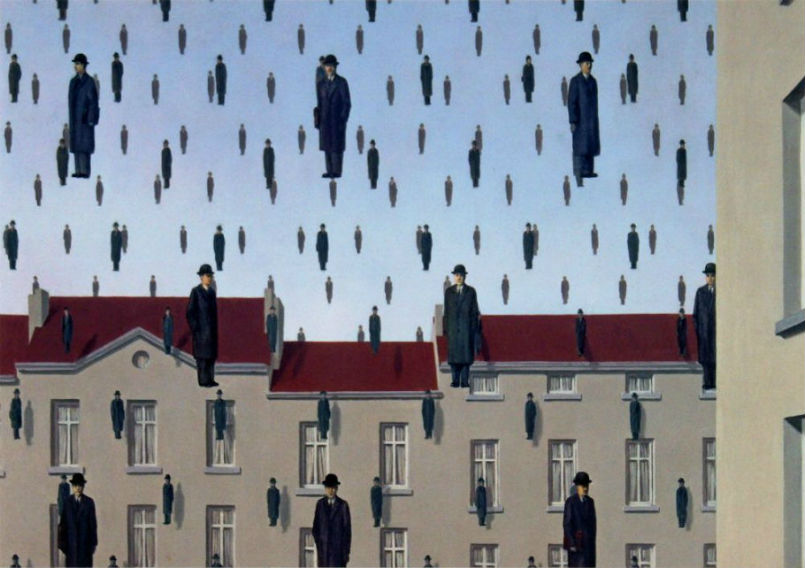
Despair Has No Wings …

To be is to despair and to despair is to remember the thousand tightly missed connections and not-yet completed conversations that will reveal themselves eventually as never really begun. The Surrealists got despair, perhaps better than most. They adopted Existentialism’s finer frustrations and rendered them with comedy, joy, and horror in sometimes strange proportions.

The comedy of coincidence and the tragedy of imminent abandonment dominate their work. Everyone is always alone, and this fact is simultaneously hilarious and horrifying in Surrealist Art.
Read More

Coloring

For those with synesthesia, the world seems no more interconnected than they assume it always is for the rest of us, until the person with the condition casually mentions how lively and bright blue the letter K always is to a playmate, who then reacts in a baffled way.

It is a condition that an unknown number of people have, but it is a condition to which the modifier “suffers” can not be added, because it does not often have negative effects on an individual’s life. (For some, it must have negative effects, just as any condition might.) It is not known how many people have or might have some form of synesthesia because not many people take the time or are offered the opportunity to describe the way they perceive how they perceive the things they perceive.
Read More

The First Paintings

The aurochs is an extinct form of cattle that overlapped with humans for tens of thousands of years. It lived in Europe, North Africa, and western Asia; the last one died in 1627. We domesticated it: Our modern-day beef cattle and dairy cows are descended from the aurochs and some of them bear a deep resemblance to the extinct animal. (Picture a bull in a bullfight, but make the animal taller and even more muscular; this would have made a bullfight a bit more even.) The reason for the extinction of the aurochs is the all-too familiar one, and it can be summed up as: Humans have enjoyed beef for a very long time.

Early modern humans, homo sapiens, showed up around 100,000 years ago, and we really started to leave a mark on the landscape around 40,000 years ago. This is deep in our prehistory, and no one knows what our Upper Paleolithic ancestors were thinking. It just appears that thinking is something they were doing.
Read More