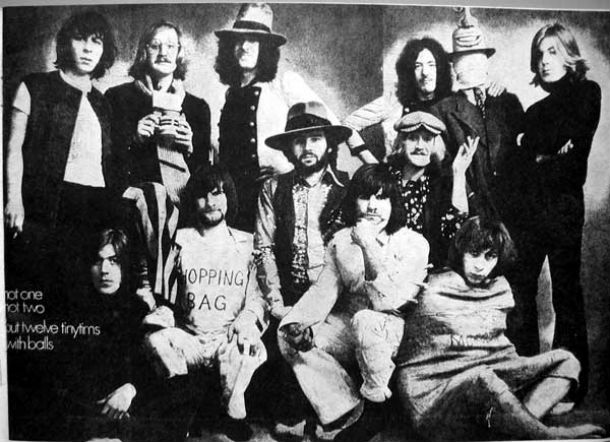
‘Today, I am two separate gorillas’

The Bonzo Dog Doo-Dah Band has received a great deal of attention in recent years. Even its Wikipedia entry has grown from a stub to a forty-paragraph historical disquisition in a few short years, which surely must be a sign of something, with fourteen footnotes, two sources, and five “for further readings.” (Thank you very much, Mr. and/or Mrs. Whoever Did That.)

If you are a fan of the Bonzos, nothing I may write here will do more than remind you of something you also like. If you are not (yet), nothing that I write may convince you that you have a bright future ahead of you discovering the works of these music-comic dolt-geniuses, so here is an intro anyway (“Adolf Hitler on vibes”):

For a group that was somewhat pop, mostly tongue-in-cheek, unforgettable on stage, and almost-not-quite-but-why-couldn’t-just-one-more-person-have-bought-our-record a one-hit wonder, forty paragraphs is a lot. So perhaps I am not alone in my fandom. One of the pleasant surprises in writing this website has been the number of hits that a post I wrote about Bonzo founder Vivian Stanshall has received (in triple digits since March).

The Bonzos served as a bridge, a missing link (if you were looking for one) between The Beatles and the Monty Python group. In late 1967, the Bonzos appeared in both “Magical Mystery Tour” (partially entertaining the Beatles—John Lennon heckles them—with a performance of their song “Death Cab for Cutie”) and in the pre-Python but mostly Python-staffed afternoon television show, “Do Not Adjust Your Set.”

Here, from “Do Not Adjust Your Set,” a pre-Python Michael Palin introduces the Bonzos and Stanshall does his best worst Elvis in “Death Cab for Cutie.”

In most of their performances, Stanshall was the lead singer, focus of attention, easily distracted emcee, and camera hog whenever one was present. The basic Bonzo line-up was Neil Innes, Rodney Slater, Sam Spoons, Roger Ruskin Spear, Vernon Dudley Bohay-Nowell, “Legs” Larry Smith, and Bob Kerr. At times, the group was down to three members (when an album was required to meet a contractual obligation) and at others, more than a dozen musicians and affiliated acts might be occupying the stage.

As head song composers, Stanshall was paired up with Neil Innes, but according to Innes, “Death Cab for Cutie” was the only true collaboration between the two heads of the head-less Bonzos, because it was the only time he and Stanshall were actually in the same room while writing. Stanshall wrote wordplay-heavy songs with lines that were saturated in nonsense, and Innes was (and is) a songwriter whose Beatles-esque tunes led not only to to the Bonzos being produced by Paul McCartney (the minor hit “I’m the Urban Spaceman,” which qualified the group as an almost one-hit wonder) but also to a Beatles lawsuit in the 1970s when music he wrote for his parody group, the Rutles, was found to be too reminiscent for comfort. Several Innes songs for the Rutles now list Lennon-McCartney as co-composers. Further cementing the Beatles-Python link occupied by the Bonzos, “The Rutles” was an Eric Idle project with Innes.

Their collaboration “Mr. Apollo” combines an almost-too-catchy Innes tune with Stanshall’s absurd and long fake sales pitch for an exercise gimmick: “Five years ago, I was a four-stone apology. Today, I am two separate gorillas. No tiresome exercises. No tricks. No unpleasant bending.” The song also features a fuzzy heavy metal guitar solo, even though it dates from the era about six months before anyone had heard heavy metal guitar solos.

And here is the also too-catchy “I’m the Urban Spaceman,” which Paul McCartney produced under the pseudonym, Apollo C. Vermouth, because he was simply having too good a month in November 1968 to take credit for everything:

It is completely an Innes song, so Stanshall is relegated to court jester in performance; also, you can see how much the group dis-enjoyed lip-singing.

The Bonzos got their start in a pub in the early 1960s, when several similarly aged young men (20-somethings) hanging out there found they had similar interests, especially in kitschy old 1930s records, and started to informally perform together. Slater recounts Stanshall bringing in one such record and declaring, “Look at this! I bought it for a penny but it’s worth twice that!”

Their early performances were live and faithful renditions of the pop not-so standards that they heard on the records. But other acts were also performing live and faithful renditions of obscure 1930s records, too, so the Bonzos, many of them art students entranced by Dada, started to create their own Dadaist sound and look. The group was an act without a point that loved being an act and having no point except being an act.

By 1970, the job of jester in the court of pop music or musician in the court of comedy no longer needed to be filled. The Bonzos disbanded, sort of. Reunion line-ups performed through the 1970s and still come together. The group’s set lineup varied in name and number so whimsically anyway that it could be said that its members simply wandered away. Innes went on, as written above, to a long and varied career continuing to bridge a gap between comedy and pop music. Most of the surviving members are jazz musicians who will always be remembered as Bonzos.

The group celebrated its fortieth anniversary in 2006 with a live show that featured special guests like Stephen Fry. What it was the fortieth anniversary of was up for discussion, but 1966 was the year the group came to the attention of the larger British public, as it landed its first major label record deal and appeared on television for the first time.

And Vivian Stanshall. He died almost twenty years ago, in March 1995, because he used to smoke cigarettes and drink brandy in bed and those two things do not mix well with nodding off. He is one of those artists about whom one marvels at his inventiveness, at the waterfall of words most of his work produced, and still feels that his career was somehow smaller than it was meant to be. I certainly disagree. (I am sure his non-ghost is not thanking me, anywhere.) He left the world wanting more of him, which is what performers are always told to do.

Here is a BBC documentary about Vivian Stanshall from 2004, “The Canyons of His Mind“:

____________________________________________
The WordPress Daily Prompt for December 15 asks, “We all have our semi-secret, less-known personal favorites—a great B-side, an early work by an artist that later became famous, an obscure (but delicious) family recipe. Share one of your unsung heroes with us—how did you discover it? Why has it stayed off everyone’s radar?”

* * * *
Please subscribe to The Gad About Town on Facebook: http://www.facebook.com/thegadabouttown

Bring Back the ABCs

About fifteen years ago, give or take, some friends and I started exchanging by email these twenty-six-word-long prose-poems which one of us took to calling “abecedarians,” because that is what they are called.

In Merriam-Webster, an abecedarian (noun) is a novice learning the rudiments, the beginning steps, of something. (How does one learn the alphabet?) My friends and I were turning an adjective into a noun: an “abecedarian sequence” is a set of things arranged alphabetically; we were writing abecedarians, twenty-six word paragraphs that sometimes almost meant something. It was our own invention.

(Actually it was not. Robert Pinsky, the former poet laureate, wrote an ABC poem, appropriately called “ABC”:

Any body can die, evidently. Few
Go happily, irradiating joy,

 
Knowledge, love. Many
Need oblivion, painkillers,
Quickest respite.

 
Sweet time unafflicted,
Various world:
X=your zenith.

And he found a terrible solution to the X Challenge, which confronts every pursuer of the perfect abecedarian. “X=your zenith.” Oh, sweet honey and the rock, that’s awful, but most of them are.

As my friend John, who started the thing off, wrote, “They are awfully fun to speed-write stream of consciously while at work or elsewhere.” Yes, at work. At the time, I was creating instruction manuals that had parts labeled A, B, and C on our illustrations (one had so many parts that it went around the alphabet and even used AA, BB, CC), so I could claim my abecedarians as work-related research.

Here are a few, which all date from spring 2001 and my work email account:

Alan’s bountiful charms developed even further God’s handiwork. “It justifies knives, leaving me nearly … oh, perfect. Questions? Rotten stuff, that ugliness.” Vigorously wiggles. “XXX!’ (Youth’s zenith.)

 
I have not included my friends’ offerings because they ought to be under their copyright, should they wish to ever use them. All of these are mine.
 

A bistro coffee (decaf) eventually forces growing humility: “It’s just Kona.” Let me notice our position: “Quality really sucks. Totally.” Underlined violently. Wow. Xed-out of your Zagats.
 
“Alright, boisterous Charles, dedicated event financier, go have imagined justice, Korean laughter. Man no open parapets! Question revolutions solving truth! Until vile wishes X-tend, Yours, Zebediah.”
 
Another behemoth cooed delightedly, elevating Father Gordon H. Ionesco’s jowls kinkily. “Lovely monster.” “Next opinion?” pressed Questa Rodriguez-Sanchez, totally unimpressed Vice-Warden. “X- X- X-” yammered Zionist.
 
Ambient balloons clownishly detour eccentric focaccia; gorgeous Hellespont invokes judicious knowledge; lovely millionaire Newton optimistically predicts qualm-free results, sending trivial ultimatums violently wandering; “‘xtraordinary,” yawns Zeus.
 
August Browning captures Dardanelles easily from Germany. He insists jokingly kangaroos leave momentarily; nodding openly, primly querying “Really? So they …”, urging Victor Watson: “X-coordinate! You Zed!”
 
A broken cut developed easily from goring hunters into juicy Kosciusko-less millions now, or perpetually, quelling righteous salves thick under victory while xaviering your zoo.
 
All boyos consider donuts easy food, guessing heavy-duty, intelligent judges know leisure-time munching no-way offers possible questions re: sluggish, tortoise-like, useless, vitamins, where X-Street’s youths zip by.

The abecedarian pieces filled my email world for a couple of months, with even my mother and sister joining the fray. According to my email account (my Yahoo mail, which is no longer my main email, but I keep it active as it is a historical record of fifteen-plus years of historical records), I attempted to revive the phenomenon five years later, which is now almost nine years ago. There were no takers. The abecedarian moment had been a flash in the pan.

One final piece of history: Some who are students of religion will remember that there was once a sect of Anabaptists in 16th Century Germany who called themselves “Abecedarians.” The Anabaptists did not call themselves this term, which roughly translates from Greek as people who “baptize twice.” They were ridiculed and worse, persecuted, for baptizing adults who had been baptized in infancy, but that was their point: Infants can not confess their faith, so they are not candidates for true baptism. Belief comes from within and baptism is for those who can understand. The Abecedarians took this further and held that all human knowledge is an impediment to being saved, that to even know the letters of the alphabet is to consciously block God’s word from the human heart. Hence their name.

A new one:

About Butch Cassidy Don English found good heightened information: Just knowing lies makes not one person quite really sated. Try under “Violence,” William Xavier. Yours, Zara

____________________________________________
The WordPress Daily Prompt for December 13, 2014, asks, “Write down the letters of the ABC. For each one, choose a word that begins with that letter. Now, write a post about anything—using all the words you’ve selected.”

* * * *
Please subscribe to The Gad About Town on Facebook: http://www.facebook.com/thegadabouttown

A Christmas Tree Story

I am sitting in my girlfriend’s office looking at her office Christmas tree. It is white, snow white, like a snowman in a a Rankin/Bass stop-motion cartoon. (Paul Frees would provide the voice.) We will be trimming it in a few moments.

office xmas

A white Christmas.

I think that tree trimming was my least favorite trimming when I was young. I still lack the eye necessary for decorating a tree correctly; in fact, I believe that almost every tree I have attempted to decorate has been quietly fixed upon my leaving.

(Two things transpired within moments of me writing the above: 1. My girlfriend credited me with expanding her notions of tree decoration—she said, “You’re the first person I’ve seen who does not put all the decorations on the ends of the branches,” which is true, I sometimes place them on the middle or even closer to the trunk; and 2. We found that I had overloaded one section with the same color ornament and we needed to correct it.)

One winter, a friend enlisted me in a project to cut down a real live Christmas tree from a Christmas tree farm so her son could experience a Christmas like the one she and I had never ever had. (The sum total of my experience with freshly cut Christmas trees was buying one in a parking lot from a seller who was asked by the police to pick up his trees and move it along seconds after we made an offer. We did not receive an “Everything Must Go Because I Am Being Busted” discount.)

Neither my friend, her seven-year-old son, nor I knew what cutting a live, six-foot-tall or smaller tree would take, so we brought the only saw that she knew she had. (I believe it was one that her uncle had rejected forty-five years earlier for one that was actually sharp; now, forty-five years later, it also had some rust.) We then drove to a tree farm in Dutchess County, New York. I have chopped wood plenty of times, and I have helped take dead trees down; neither of these experiences served me on this day.

The first task in cutting down a fresh Christmas tree for oneself is finding something to occupy the seven-year-old son of your friend—allowing the child to select the winning tree to preserve your friendship with his mom is advisable. Next up is failure in the negotiations with the seven-year-old to pick a tree that is not on a steep, snowy slope. (Happy people with skis were walking almost as far up as our tree was located. Almost. I was wearing sneakers.)

Many will ask the question, “Should I cut two notches to make a V or cut straight across?” I know I did, just not out loud or in the presence of someone who could tell me the answer. With my tiny, rusty saw and no one holding the other side of the saw, I started notching one side of a V. The blade sliced some bark off and did not penetrate the green wood underneath. The snow had already penetrated my shoes, though. The trunk was no thicker than two inches wide, if that—hey, I’m no tree-ologist!—but it was quickly apparent that I was going to need help.

With that in mind, I drove away my companion and her son with my grumpy “attitude.”

After an hour alone, my inner debate over cutting straight through versus cutting a V had produced several partial starts—some up, some down—all the way around the trunk of the tree. Instead of a V, I had notched something like a lowercase w but less useful, partway to the center of the tree. My friend returned and we commenced cutting straight across, because it was “taking me too long,” when we discovered together that there is nothing quite as unsatisfying as the sound of a tree not coming down no matter how far one has cut through it until it is ready to come down. Nothing unites like mutual frustration.

It eventually came down. I accompanied it down the slope … okay, I rode it down the hill like Slim Pickens at the end of “Dr. Strangelove.” I had not reminded my friend or her seven-year-old son to bring rope to tie it to the roof of her car, so we drove home with it sticking out one of the backseat windows. In my lap.

* * * *
My family had one plastic tree for twenty or more Christmases. It was a well-constructed one, actually, a bare metal trunk with a two or three hoops to hook in each individual branch around the tree. It actually had an instruction manual. Our Christmas tree and boxes of ornaments occupied several boxes in the basement; the annual production of “putting up the tree” was my introduction to grown-ups not being able to remember from one year to the next the locations of things they put away in the same box in the same place every year. And now I am that grown-up.

I am sure that my mother and father found it necessary to re-position my ornaments; I swear that something happens to me when I approach a tree, ornament in hand. I have hooked ornaments into shirt buttonholes when I swear I was aiming for the tree. Just as I wanted to cut my one live tree down in one graceful and strong sawing motion, I always want this ornament here and now to be the first, last, and only one needed to make this year’s tree the complete and perfect Christmas statement. I want someone to exclaim, “This is the most Christmas ever!” Christmas brings out the perfectionist in all his mistake-prone grumpiness in me.

Thus, the only part of decorating that I relax and enjoy is either throwing tinsel everywhere or putting the angel on top. (That is an unsung rite of passage, growing tall enough to top the tree with a star or angel.) We had an angel, a cardboard seraph with glued-on glitter and thin, stringy blonde hair. Its halo was glued-on, as well. But it was our angel, and when nicer, more expensive-looking, ones found their way into our house, they were always relegated to lower branches. My family’s underdog mentality extended to angels.

That mentality may have been the best, most lasting, gift from my family.

* * * *
(An earlier version of this was first published last December on my previous website. My girlfriend and I will be decorating the tree again this weekend.)

____________________________________________
The WordPress Daily Prompt for December 11 asks, “As it’s been a while since our last free-write … set a timer for ten minutes. Write without pause (and no edits!) until you’re out of time. Then, publish what you have (it’s your call whether or not to give the post a once-over).”

* * * *
Please subscribe to The Gad About Town on Facebook: http://www.facebook.com/thegadabouttown