In honor of Stephen Colbert’s final “Colbert Report” tonight, here is a column I wrote in September about attending a taping of his show. Thanks for the memories, Stephen (and Gerry and Theresa).
Comedy Central’s two main franchise shows are both recorded in a part of New York City called “Hell’s Kitchen,” a section of Manhattan that extends about 25 blocks south and west of Central Park and west of Midtown over to the Hudson River. Most of the buildings in the neighborhood are former walk-ups and townhouses that are now offices for media companies; “The Colbert Report’s” studio looks like it was a house or storefront once upon a time.
The Thursday, September 18, 2014, broadcast of “The Colbert Report” was a very special one because I was in the audience, as I wrote yesterday, in “Four Minutes and 24 Years.” Terry Gilliam, the legendary film and theater director (the list is epic and includes: “Time Bandits,” “Brazil,” “The Fisher King,” “Fear and Loathing in Las Vegas,” “The Zero Theorem”) and Monty Python animator and cast member, was the guest.
It was my least favorite question in school. “What do you want to be when you grow up?”
On one occasion, I remember being forced (forced!) to draw what I pictured my life to look like. If I had had the sense of humor I claim to have now, I would have drawn someone who was capable of drawing. Maybe I would have drawn someone holding a board with many colors on it. The person would be wearing a smock. (That was how Mr. Volk, our art teacher in elementary school, dressed. It was almost a parody of a cliché of someone’s idea of an artist.) The caption to my drawing would have stated that I hoped I would be able to draw when I was a grown-up.
Or maybe I could have drawn something representing a desire to be funny someday. A “Tonight Show”-type desk or a microphone in front of a brick wall. But no, as when I was asked to verbalize what I wanted to do when I was a grown-up, which I reacted to like it was a trick question, as if there was a perfect answer that I could glean by reading the cues from my questioner (“Mrs. Arms wants me to say that I want to be an … astronaut! I’ll draw an astronaut.”), I could only draw a stick figure wearing a tie. I want to have a job. Isn’t that what I am supposed to say? It’s already afternoon and there’s an Abbott and Costello movie on, so can I go now?
Except I would never say out loud to anyone that there was something I would rather be doing, like watch a movie. As a kid, I think I saw adults as something to be tolerated. They did not know more than me, and those that I conceded did know more were pushy about it, which is I why (I guessed) they were teachers. My stick figure with a tie (red, in my memory) was basically my dad, the only adult with a job that I was aware of. (Teachers? I am sure I wondered how that was a job. The freakiest thing in life—ever!—came whenever we saw a teacher in the grocery store, in the outdoors life. They shop? Doesn’t the janitor just fold them up and put them in a storage closet at the end of the school day, once the last detention bus has pulled away and a ride had been found for the last kid whose parents were divorcing and screwed up the daily negotiations over who was supposed to pick her up?) My stick figure with the red tie represented my eight-year-old’s deep inner knowledge that I was destined to be someone’s employee, probably working with or on numbers instead of what I thought I wanted, which I did not think anyone wanted for or from me: to work with words and sentences.
I also never imagined, neither out loud nor on paper, in writing or in stick figures, a family life. My imagination was that limited. Marriage and family appeared (in my limited view) to be things that people seemed to fall into upon arriving at a certain age. For me, something never envisioned became something never worked toward. One does not live to be 43 and single without some effort at failure devoted to the cause; the wonderful news is that I am now 46 and not single, and life has opened up for me.
As a kid, I simply did not see the point to imagining something in the far-off future. Why bother when it is going to be so different? My gosh, I wish I had had the foresight to say something like that out loud to my teachers. I just tried to read their prompts for what they seemed to think I should say I wanted. “Draw your dream house.” I drew the house I then lived in, a three-bedroom, single-level ranch, the only home I’d known, but in a different color. With a swimming pool. Within a year, in real life, the house had been painted (not my imagined color) and a swimming pool installed. See? The distant future, my distant future, would take care of itself.
It has taken care of itself, I guess, in that I am still here. The only distant date that caught my imagination was 2000. In the 1970s, that year always came with a preface: “In the year.” “In the year 2000, I will turn 32 and … perhaps have a more detailed and creative imagination than the one I have now, in the year 1979.” But ever since then, in adulthood, every time I have written out a five-year plan, I have veered completely off from it within six months. The one time I started a 401(k), I lost that job within a week. Eight months ago, my housemate and I were supposed to move to a new apartment and the very day that I officially changed my address with the post office, a task that nowadays is more of an official-sounding representation that one is moving than it is something totally necessary, that very day, thirty minutes after filling out the post office’s online form, I was told by my housemate’s mom (of all things) that I was not a part of the move and that my housemate had been lying to me about the move for six months. Two very positive things resulted: I moved in with a part of my girlfriend’s family and my girlfriend and I are closer together; I no longer live with a sociopathic housemate or the mother. Life has taught me to retain my lack of a detailed and creative imagination and yet be open to possibilities.
Because I did not have an idea of adult life, my life so far has been nothing like what I imagined. There is a difference between being a grown-up and an adult. For much of my life, I have been a “grown-up,” that stick figure with a red tie that I drew long ago. On good days, I wore a tie and looked like I was an adult, but was not. I would hold a job for a while and become bored or distracted by what could come next or stressed that I was expendable (the perpetual worry of a stick figure) and move to the next part of life. I remained open to possibilities, but sometimes the possibilities grew narrow. They no longer are.
I wanted life to be interesting. I wanted to be kept interested, interesting, and entertained. My life has been all of that and still is. It really is an adventure.
____________________________________________ The WordPress Daily Prompt for December 17 asks, “Tell us about the object of your dejection—something you made, a masterpiece unfinished, or some sort of project that failed to meet your expectations. What did you learn from the experience? How would you do things differently next time?”
The only message worth devoting much time and effort to communicating is love. Today, a sad news day, is a good day to remember that.
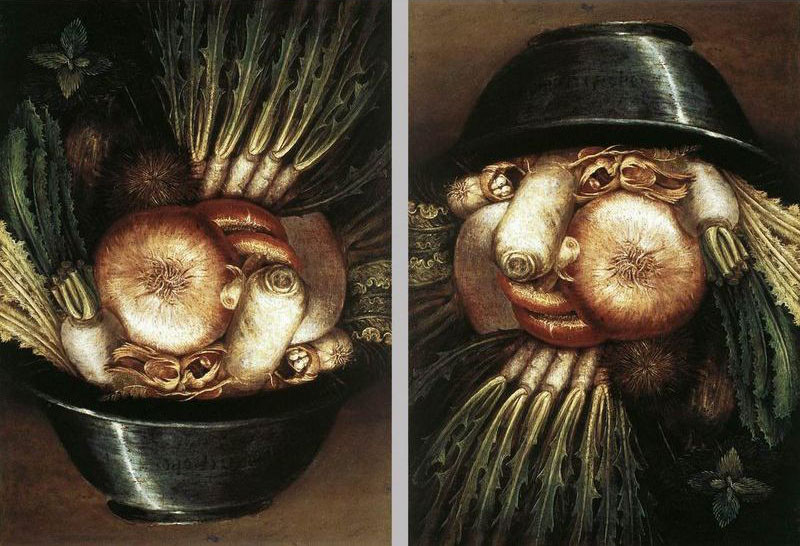
A few months ago I wrote about two artists who played with the question of whether what they are depicting is anything more or less than words on a page or paint on a surface. Both George Herbert and Arcimboldo (and Andy Warhol, in his own way) make art of the question, What is art? Is it what it depicts, an idea about what it depicts, both at the same time (which makes it a third option), or something less than? Is art, by definition, always a misfire, in that a depiction of a thing is not the thing and never can be?
Arcimboldo painted portraits of character types rather than individuals; for instance, a librarian composed entirely of books or a gardener made of vegetables in a bowl. That latter painting depends on the viewer to decide to see the bowl filled with veggies or a human “face.”
When is a face a face and when is it a bowl of root vegetables? When is a painting a painting and something greater than a collection of chemicals on canvas?
Vegetables In A Bowl, Or, The Gardener
George Herbert wrote poems about the only idea that he deemed to be worth considering: The eternal love of his Christian God and man’s time-and-space-and-language-constrained attempt to return that love. Two of his poems are written in the shape of what they are about. Like Arcimboldo painting a root vegetable for a nose, Herbert uses words to build an item; in one, “The Altar,” each word is a “stone” making up the altar that the poem is conceived as being:
A broken ALTAR, Lord, thy servant rears,
Made of a heart and cemented with tears;
Whose parts are as thy hand did frame;
No workman’s tool hath touch’d the same.
A HEART alone
Is such a stone,
As nothing but
Thy pow’r doth cut.
Wherefore each part
Of my hard heart
Meets in this frame
To praise thy name.
That if I chance to hold my peace,
These stones to praise thee may not cease.
Oh, let thy blessed SACRIFICE be mine,
And sanctify this ALTAR to be thine.
One word, a single syllable, too many or one word mislaid or deleted, and there is no altar there. It is an altar made of words but no less central to the life of a church than an altar made of stone. The poem appears in the only book of poems that he compiled himself, a book titled “The Temple,” which walks the reader, a “dejected poor soul,” through a church. Thus, his altar, “The Altar,” is central in the book. (At Herbert’s request, the book was published posthumously, with his stated desire that it might bring “consolation of [to] any dejected poor soul.”)
It is probably an untranslatable poem, in fact if not sentiment. (Indeed, an admittedly brief survey has not yielded one.) The shape of the poem is dictated by the number of syllables in his choice of words; it is a translation of an object, a real thing, into words anyway, and as such is forever a failure. It is a “broken altar.” The human heart is the only perfect, unbroken, stone for worship, is the only true altar. All that his mind can make is something out of these pieces of meaning, words, and if he can get out of his own way (“if I chance to hold my peace”), these words as assembled here only exist to worship and love. They are what they are, words, and the words each on their own are not an altar, and a spoken version of this poem is not an altar, either. When is an altar an altar? At what point is a poem something other than, more than, words on a page?
However well-constructed it may be—it looks like an altar, for crying out loud—it does not matter. It is no altar. Not even a photorealistic painting of an altar would be an altar. Further, no altar is truly an ALTAR, as no earthly object is made of the only stone of faith that exists: the human heart “cut” by God.
Herbert’s faith was that of a man for whom questions about faith were a part of it. His worship and his poetry exist in a space of failure, where a poem of an altar is not an altar but is a sort of altar, an attempt at one. His poetry depicts a figure who is struggling in every way to comprehend and return eternal love and who is met every time by a figure who replies that it is all a bit easier than he is making it. But all I have is language, Herbert’s speakers proclaim: “We say amiss / This or that is: / Thy word is all, if we could spell.”—”The Flower.”
Herbert often describes the moment when the perceiving of love comes easily, and it is always sensuous, often reads as if it is written to a new love:
Who would have thought my shriveled heart
Could have recovered greenness? It was gone
Quite underground; as flowers depart
To see their mother-root, when they have blown—”The Flower”
But Herbert’s worshipper is always doubting himself, his faith, whether his faith is correct or not. In “Love (iii),” Herbert’s speaker is an unworthy guest in God’s (Love’s) home, but his host is gently persistent:
Love bade me welcome: yet my soul drew back.
Guiltie of dust and sinne.
But quick-ey’d Love, observing me grow slack
From my first entrance in,
Drew nearer to me, sweetly questioning
If I lack’d anything.
A guest, I answer’d, worthy to be here:
Love said, You shall be he.
I the unkinde, ungrateful? Ah, my deare,
I cannot look on thee.
Love took my hand, and smiling did reply,
Who made the eyes but I?
Truth Lord, but I have marr’d them: let my shame
Go where it doth deserve.
And know you not, sayes Love, who bore the blame?
My deare, then I will serve.
You must sit down, sayes Love, and taste my meat:
So I did sit and eat.
So if poetry is always at best an approximation of True Love, why not try to sing this struggle, as well? The “cheerfully agnostic” (which pretty much describes me, as well) English composer Ralph Vaughan Williams created five songs out of four Herbert poems a little over a century ago. The suite is called “Five Mystical Songs,” and one, “Love Bade Me Welcome,” is a setting of “Love (iii).” Some churches use the last song, “Antiphon,” as a hymn sung by the congregation.
Here is Sir Thomas Allen performing the set (in two sections) with the BBC Symphony Orchestra:
____________________________________________ The WordPress Daily Prompt for December 16 asks, “You have to write a message to someone dear to you, telling that person how much he/she means to you. However—instead of words, you can only use 5-10 objects to convey your emotions. Which objects do you choose, and what do they mean?”




 The Gad About Town