It was my least favorite question in school. “What do you want to be when you grow up?”
On one occasion, I remember being forced (forced!) to draw what I pictured my life to look like. If I had had the sense of humor I claim to have now, I would have drawn someone who was capable of drawing. Maybe I would have drawn someone holding a board with many colors on it. The person would be wearing a smock. (That was how Mr. Volk, our art teacher in elementary school, dressed. It was almost a parody of a cliché of someone’s idea of an artist.) The caption to my drawing would have stated that I hoped I would be able to draw when I was a grown-up.
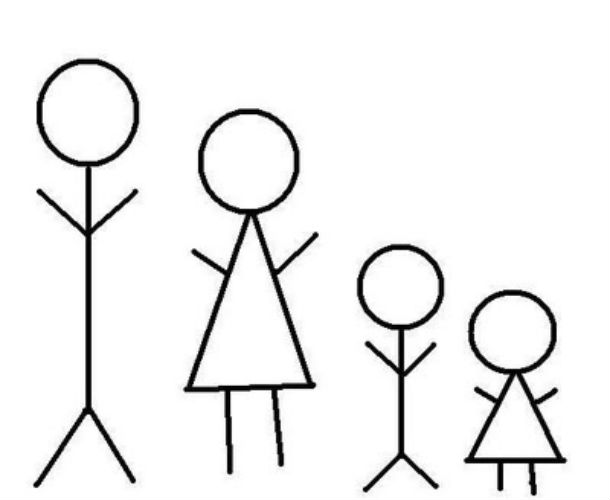
Or maybe I could have drawn something representing a desire to be funny someday. A “Tonight Show”-type desk or a microphone in front of a brick wall. But no, as when I was asked to verbalize what I wanted to do when I was a grown-up, which I reacted to like it was a trick question, as if there was a perfect answer that I could glean by reading the cues from my questioner (“Mrs. Arms wants me to say that I want to be an … astronaut! I’ll draw an astronaut.”), I could only draw a stick figure wearing a tie. I want to have a job. Isn’t that what I am supposed to say? It’s already afternoon and there’s an Abbott and Costello movie on, so can I go now?
Except I would never say out loud to anyone that there was something I would rather be doing, like watch a movie. As a kid, I think I saw adults as something to be tolerated. They did not know more than me, and those that I conceded did know more were pushy about it, which is I why (I guessed) they were teachers. My stick figure with a tie (red, in my memory) was basically my dad, the only adult with a job that I was aware of. (Teachers? I am sure I wondered how that was a job. The freakiest thing in life—ever!—came whenever we saw a teacher in the grocery store, in the outdoors life. They shop? Doesn’t the janitor just fold them up and put them in a storage closet at the end of the school day, once the last detention bus has pulled away and a ride had been found for the last kid whose parents were divorcing and screwed up the daily negotiations over who was supposed to pick her up?) My stick figure with the red tie represented my eight-year-old’s deep inner knowledge that I was destined to be someone’s employee, probably working with or on numbers instead of what I thought I wanted, which I did not think anyone wanted for or from me: to work with words and sentences.
I also never imagined, neither out loud nor on paper, in writing or in stick figures, a family life. My imagination was that limited. Marriage and family appeared (in my limited view) to be things that people seemed to fall into upon arriving at a certain age. For me, something never envisioned became something never worked toward. One does not live to be 43 and single without some effort at failure devoted to the cause; the wonderful news is that I am now 46 and not single, and life has opened up for me.
As a kid, I simply did not see the point to imagining something in the far-off future. Why bother when it is going to be so different? My gosh, I wish I had had the foresight to say something like that out loud to my teachers. I just tried to read their prompts for what they seemed to think I should say I wanted. “Draw your dream house.” I drew the house I then lived in, a three-bedroom, single-level ranch, the only home I’d known, but in a different color. With a swimming pool. Within a year, in real life, the house had been painted (not my imagined color) and a swimming pool installed. See? The distant future, my distant future, would take care of itself.
It has taken care of itself, I guess, in that I am still here. The only distant date that caught my imagination was 2000. In the 1970s, that year always came with a preface: “In the year.” “In the year 2000, I will turn 32 and … perhaps have a more detailed and creative imagination than the one I have now, in the year 1979.” But ever since then, in adulthood, every time I have written out a five-year plan, I have veered completely off from it within six months. The one time I started a 401(k), I lost that job within a week. Eight months ago, my housemate and I were supposed to move to a new apartment and the very day that I officially changed my address with the post office, a task that nowadays is more of an official-sounding representation that one is moving than it is something totally necessary, that very day, thirty minutes after filling out the post office’s online form, I was told by my housemate’s mom (of all things) that I was not a part of the move and that my housemate had been lying to me about the move for six months. Two very positive things resulted: I moved in with a part of my girlfriend’s family and my girlfriend and I are closer together; I no longer live with a sociopathic housemate or the mother. Life has taught me to retain my lack of a detailed and creative imagination and yet be open to possibilities.
Because I did not have an idea of adult life, my life so far has been nothing like what I imagined. There is a difference between being a grown-up and an adult. For much of my life, I have been a “grown-up,” that stick figure with a red tie that I drew long ago. On good days, I wore a tie and looked like I was an adult, but was not. I would hold a job for a while and become bored or distracted by what could come next or stressed that I was expendable (the perpetual worry of a stick figure) and move to the next part of life. I remained open to possibilities, but sometimes the possibilities grew narrow. They no longer are.
I wanted life to be interesting. I wanted to be kept interested, interesting, and entertained. My life has been all of that and still is. It really is an adventure.
(This is an edited version of a column from July, “Adults and Stick Figures.”)
____________________________________________
The WordPress Daily Prompt for December 17 asks, “Tell us about the object of your dejection—something you made, a masterpiece unfinished, or some sort of project that failed to meet your expectations. What did you learn from the experience? How would you do things differently next time?”
* * * *
Please subscribe to The Gad About Town on Facebook: http://www.facebook.com/thegadabouttown
Thank you for sharing this via one of these wonderful services:


 The Gad About Town