A Halloween Memory

The Martin Prosperity Institute has not yet released its annual survey of all things Halloween, because today is not Halloween and impatience will not change this fact.

Their work last year in the field of Halloween enjoyment, a study not seriously undertaken by most people older than eight, but a subject that the Institute has studied for three years in conjunction with the Atlantic Cities, led to many national news articles expressing shock at its conclusion: that the best place for Halloween in the United States of America is Poughkeepsie, New York.

To reiterate and emphasize key points: 1. There are fifty states. 2. All of those fifty states are pretty important in the lives of the people who live in them. 3. There are lots and lots of cities in many of those fifty states. 4. I, however, have only one hometown, and it was voted Halloween Central last year by a major little-known Canadian institute of counting things up and measuring the assessments in extremely professional ways. (Or assessing the measurements. Whichever. It was exciting news. More candy corn?)

The Washington Post expressed its perplexion with a judgmental headline, “Is Poughkeepsie, N.Y., the best place to trick-or-treat tonight?” Okay, it was not all that judgmental. Maybe it was a little sneer-y. A little dumbfounded. Perhaps a little, um, jealous?

How did the MPI come to its conclusion (since we both love my hometown so much, I think I can call the Martin Prosperity Institute by the more informal “MPI” or even “Marty”) that Poughkeepsie does Halloween better than … oh, I could list every city and hamlet in the country here, but I am no Grinch … everybody else?

According to its press release last year, titled “Trick or Treat? The 2013 Halloween Index,” the MPI measured “five variables that are integral to a successful Halloween: candy stores (per 10 thousand), costume rental stores (per 10 thousand), children aged 5-14 (share of metro population), population density, and median income.” Now, while Poughkeepsie does not rank number one in any one of these five categories, it ranked so high across the board that it beat second-place Chicago, Ill., (the 2012 winner).

Jackson, Tenn, was found to have the greatest number of costume stores per capita. Ocean City, NJ, had the most candy stores. But Poughkeepsie’s high average income and large number of costume stores sent it to number one.

See for yourself. Here is a very precise representation:

Poughkeepsie has the biggest pumpkin!

Poughkeepsie has the biggest pumpkin!

According to itself, the Martin Prosperity Institute “is the world’s leading think-tank on the role of location, place and city-regions in global economic prosperity.” “Marty” is based in the Rotman School of Management in Toronto, Canada, which is a lovely city and might be a great Halloween destination for the adventurous Halloween traveler, but Poughkeepsie.

It should come as no surprise for those of us who grew up in Poughkeepsie that our hometown is the fake spookiest or candy-sweetest or the best Halloween town in America.

Any October visitor might notice how many fly-by-night (erm, seasonal) costume stores appear along the Rt. 9 corridor every fall, or the large number of short-lived candy shops, or professionally run haunted houses, or the fact that there is a gigantic freaking (and real) cemetery smack in the middle of the whole darn Rt. 9 corridor. For those visitors—business travelers and ghouls alike—this study makes plenty of sense.

It would have made a lot of sense to my sister and me and our elementary school friends if you’d told us this back in the 1970s. I was never a particularly enthusiastic trick-or-treater. As a less-than-enthusiastic cub scout, tasked with selling items from the most boring scout catalog ever printed (two items that I remember are plastic campground dining gear and peanut brittle that outlasted the plastic dining gear), I already knew my way around the neighborhood and knew which houses were owned by people I did not like seeing in bright daylight, much less at dusk. The plastic masks—Fred Flintstone, Spiderman, Superman—were each identical except for the paint job, did not line up over my eyes, much less my eyeglasses, and were held in place by the flimsiest rubber band yet devised by human ingenuity. I could not breathe in them. Each had a cape—even Fred Flintstone, I am sure, or perhaps that was my mother’s ingenuity to keep me warm—and none earned me much candy. My less than enthusiastic cub scout side always trumped my slightly more enthusiastic begging-for-candy side.

Bordering our neighborhood, on two sides, was “The Woods.” Google Maps will convince you that the wooded area between my neighborhood and the Hudson River was not impressive, was merely undeveloped and undevelopable land left to rodents and deer and pricker bushes and some extraordinarily ordinary maples and oaks. The untrained eye will see, driving along the country road bordered on one side by The Woods, that one can clearly see to the Hudson River and unmistakably hear trains on the Metro-North line a few dozen yards away. I pity my 2014 eyes and ears. Because I knew, just knew, in 1977 that those trains came off their tracks and plunged howling into The Woods at night. And some of those rodents and deer had never before been seen by the eyes of man. They were feral and wild and wildly feral. (Never mind those firepits or the plastic forks or … is that peanut brittle?)

One Halloween Night, in 1979, I was allowed to venture on foot, not accompanied by adults and in costume (hold that thought for a second while I address my parents: What!?!) from my neighborhood to my best friend’s neighborhood, which was connected to mine by Barnegat Rd. The Woods, the scary Woods, borders Barnegat Road. Do I need to repeat this?

The best friend, Doug, loved to tell tall tales. Whenever he hosted me for a sleepover there had been a plane crash in The Woods the night before that no one was investigating (there had been no such incident) or a car had plunged down the embankment into The Woods the other night and exploded and the driver got out on fire (there had been no such accident) or his Polish grandmother had told him that there would be ghosts in 1979 that hadn’t been seen in many many years (he had no Polish grandmother). Doug was five days younger than me and creatively lazy and this made him a respected authority in my eyes. (I hope he is someone’s parent nowadays.)

At just the perfectly wrong moment, while he and I walked from his neighborhood back to mine, loot in our identical plastic pumpkin pails, just as he was committing with his words some luckless fictional airplane pilot to a fiery death earlier that very day a mere few feet from where we were walking, just then, my flashlight went dark. We started to walk at a faster pace. There truly are few streetlights on that road, and even fewer in my memory. I had never seen a night so dark or learned of a death so imaginable. Just then, we heard a sound. A low, rasping scream of an anguished, crying creature—Doug had found his true calling as a storyteller, at least this one night, and both of us bolted from what was obviously the ghost-tortured mortal remains of his burned-up pilot or a ghost of a train engineer come to steal us from Poughkeepsie, which for us was already the best Halloween city in the country.

____________________________________________
The WordPress Daily Prompt for October 30 asks, “Today you can write about anything, in whatever genre or form, but your post must mention a dark night, your fridge, and tears (of joy or sadness; your call). Feel free to switch one ingredient if you have to (or revisit one from previous trio prompts).” I switched one. The fridge became a flashlight.

* * * *
Please subscribe to The Gad About Town on Facebook: http://www.facebook.com/thegadabouttown
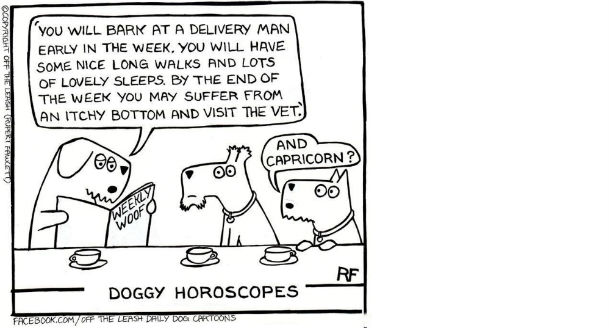
Scoping a Horo

The first rule of horoscopes is to remember that your horoscope is not written for you. It does not address you specifically. Horoscopes are written for “people like you,” which is to say that you should read them like a person like you, but a you who reads horoscopes, understands them, and trusts them.

Any complaint about a daily horoscope’s failure to discuss or predict your lunch, daily expenses, or death are the complaints of a person with laryngitis to a lamp.

People like you are those who were born around dinner eastern standard time on November 18 at 41.7000° N latitude. I am one of those people like that: we are called Scorpios, and like many a Scorpio, I am passionate and faithful and fall in love daily and I am also mistrustful and perpetually isolated in my own unemotional head. Like many Scorpios, I am devoted to my friends and cruel as bureaucrat denied a raise just before taking your call. Like many Scorpios, I am kind and rude, instinctual and devoted to logic, whip-smart and dumb as a box of string; I am both and neither in so many ways and all of none of them at all most of always. Perhaps you can and can not relate, if you are and are not a Scorpio.

Here is the Scorpio horoscope published for the month of October 2014 in a truly great local magazine (that is not sarcasm; the Chronogram really is a great Hudson Valley magazine and I even wrote one article for it in the 1990s); there are still a few days left for all of this to come to pass or none of it to come true or all of it to not come true in a way that spookily proves it was correct from day one: (ahem)

You may be wondering when things are going to change; you may start to think you’re going backwards rather than making progress. You may seem to lose sight of an important goal, or some crucial idea that you’ve been developing. Fear not. The astrology of the next few weeks is certainly mysterious and will leave plenty of people guessing. Yet as those weeks unfold, you will discover that something is brewing under the surface, and that something is likely to manifest on the day that the Sun ingresses your sign, which is October 23. Now, this leaves a question of what to do if you find yourself in a zero-gravity space, or feeling like you’re unable to think clearly. Your chart says that you will get maximum value from getting lost in your work. Proceed with what you are doing, with full devotion, authentic passion and a healthy dose of curiosity. Imagine that you have no need to think about what’s coming next, nor any desire to do so. Keep yourself focused on the task at hand, which over the next two weeks is likely to get more interesting and take on a value of its own, that is, to be interesting for its own sake. You could call this art or science in its most essential and sincere form, which is the setup for an inevitable breakthrough

The paragraph ends with no punctuation, neither a period nor an exclamation point. The other 11 monthly zodiacal missives for October’s impending October-ness (these were published on October 1th, right split-lickety) all conclude with concluding punctuation. Minor typo? Absolutely; every publication (even this one) has typos. They are a fact of life, like dust on a computer screen or sunlight. But might this absence mean something? What if I “act as if” and read it—the typo and the entire horoscope—as if it means something?

An “inevitable breakthrough”? That sounds exciting. But can a breakthrough be a breakthrough if it is inevitable? Don’t I have to be a participant for an event to be a breakthrough, and if it is inevitable aren’t I not a participant but a bystander?

It still sounds exciting and I can not wait for October 23, which was … last Thursday. What happened then? The sun was ingressing my sign. I wrote a throw-back Thursday piece that day, which covered the past (an old photo), the present (an award this blog had won), and the future (I concluded with a sentence about wanting to learn to meditate, which was unrelated to anything else I had written). Um, wow.

The horoscopianizer was right: the sun was ingressing all over my place last Thursday, but that may be only because I don’t have any curtains and my room faces the sunrise.

____________________________________________
The WordPress Daily Prompt for October 29 asks, “Yesterday you invented a new astrological sign. Today, write your own horoscope—for the past month (in other words, as if you’d written it October 1st).”

* * * *
Please subscribe to The Gad About Town on Facebook: http://www.facebook.com/thegadabouttown

‘The Way’

At one point in “The Quest,” his modernist version of a quest romance told in 20 sonnets, the poet W.H. Auden derides occult fascinations as “an architecture for the odd.”

The particular sonnet, which in some editions is titled “The Tower,” but in Auden’s official Collected Poems is simply called number “IX,” concludes with a warning from magicians caught in their own tower:

Yet many come to wish their tower a well;
For those who dread to drown, of thirst may die,
Those who see all become invisible:

Here great magicians, caught in their own spell,
Long for a natural climate as they sigh
“Beware of Magic” to the passer-by.

Contemporary pop astrology is one of those towers, as Auden might call it. The zodiac is a carving up of the night sky according to real geometry, with each of the twelve signs occupying a perfect 30°, which lends it a mathematical credibility and grounds it in things we might consider “real.” Pop astrology is not real. Once upon a time, the zodiac was a coordinate system grounding observers in a spot on the earth (if this star is in the sky at this angle I must be in Iowa) at a particular time at night (if this particular star is in the sky at this angle it must be autumn; further, it must be 1:00 a.m. Now, how did I wind up in Des Moines?) and so it was very useful. The sky was every traveler’s GPS. The zodiac was one way of reading it.

The belief that there is a connection between things happening on Earth and things happening in the night sky at the same time is such a seductive one that it has transcended human eras, societies, religions, and politics. Dictators and democrats alike have believed in auspicious and inauspicious times to begin initiatives or end policies. (Or lives.)

It is understandable that we humans would think of ourselves so non-humbly, that we would see ourselves not only as the conclusion to nature’s long eternal statement but that we would view ourselves as not merely a conclusion, a period mark, but as THE conclusion, an exclamation point. We are the one who knocks. We aren’t much, but we’re all we think about. In the universal scheme of things, however, humanity’s history may not even show up as a comma in eternity’s sentences.

And that is just fine. Nature or the Big You Know Who Upstairs granted us a wonderful gift, life, for no reason at all, which is the definition of grace.

The zodiac is as attractive as it is, even for those who recognize astrology as a human attempt to think like a god, because it contains and describes just about every human flaw and foible and positive attribute and success in such a compact container that it makes almost every human type seem predicted and even predictable. It appeals to writers for those same reasons, writers who were Jungian long before Jung existed. People born on November 18 (my birth date; it was a Monday, at dinnertime, 41.7000° N latitude) may carry with them certain tendencies and characteristics, or they may not, and the beautiful thing about astrology is that both of those statements—we may be similar and we may not be—are equally true. There is no need, or way, to add to such a comprehensive package.

In skies far from here, our sun might be a part of a constellation dictating zodiacal decisions on some other planet, in alien eyes wondering up at a night sky very different from and yet very similar to ours.

Sonnet number XIV of Auden’s cycle “The Quest” breaks with the previous chapters and their preoccupation with classical sonnet structures—Petrarchan, Shakespearian—and is written in a couplet form. It asks a question that is difficult for both skeptics and believers to answer: “[H]ow reliable can any truth be that is got/By observing oneself and then just inserting a Not?” In some editions the poem is titled “The Way.”

Fresh addenda are published every day
To the encyclopedia of the Way,

Linguistic notes and scientific explanations,
And texts for schools with modernised spelling and illustrations.

Now everyone knows the hero must choose the old horse,
Abstain from liquor and sexual intercourse,

And look out for a stranded fish to be kind to:
Now everyone thinks he could find, had he a mind to,

The way through the waste to the chapel in the rock
For a vision of the Triple Rainbow or the Astral Clock,

Forgetting his information comes mostly from married men
Who liked fishing and a flutter on the horses now and then.

And how reliable can any truth be that is got
By observing oneself and then just inserting a Not?
— W.H. Auden, XIV, “The Quest

____________________________________________
The WordPress Daily Prompt for October 28 asks, “You’re tasked with creating a brand new astrological sign for the people born around your birthday—based solely on yourself. What would your new sign be, and how would you describe those who share it?”

* * * *
Please subscribe to The Gad About Town on Facebook: http://www.facebook.com/thegadabouttown