The Fall of the Berlin Wall

The demolition of the Berlin Wall started 25 years ago today, November 9, 1989. Nine days later, I turned 21, so every minute of my first 21 years except for a week was lived in the bipolar world of the Cold War.

Us versus them. It was served with our breakfast cereal, our school lunches, and the nightly news watched during dinner. The Cold War was a fact, a background noise, a tinnitus-like hum heard 24/7, sometimes from far away and sometimes next door. Its removal seemed to make us aware that it had always been there, how loud it was, and that it had been driving us all insane.

Since 1989, there have been many movies set in post-apocalyptic nightmare futures but by the mid 1980s our movies were starting to entertain the notion of depicting the apocalypse itself; in 1964, “Dr. Strangelove” ends with a sequence of images of mushroom clouds, which is shocking and direct—and very far away. On November 20, 1983, ABC television aired a made-for-TV movie called “The Day After” which graphically depicted the moment of apocalypse. In Kansas. (According to its Wikipedia entry, it remains the highest-rated made-for-TV movie in American television history.

A military build-up in East Germany leads to a standoff and diplomatic breakdown and both sides launch missiles. The movie does not dwell in the plausibility of the geopolitical story, though, since that really would not matter to innocent citizens on the ground; it shows the missiles exploding and the instantaneous and not so instantaneous deaths everyday people would experience. Conscientious history teachers sent their pupils home with requests that the students be allowed to watch in order to participate in discussions the next day; ABC announced at what minute the most horrifying scenes would begin (I seem to remember the broadcast was commercial-free).

My parents did not sign; I remain one of the few who did not see “The Day After.”

vilniusbBy 1989, it appeared that the end was beginning. In January of that year, I traveled to the USSR with a school group. We saw what it looks like when a country maintains borders not to keep people out but to keep its own citizens inside. In Vilnius, Lithuania, a truly beautiful city, an elderly woman approached us (our professor was Lithuanian, so he translated) and declared, “God bless Reagan!” In Kiev, Ukraine, something similar happened but the elderly woman did not need to be translated; she said it in English. In Leningrad, the same thing.

(I happen to be a liberal, a Democrat usually, and this love for Ronald freaking Reagan was not winning any points with me. But even I understood what was happening. I just wanted some love for Michael Dukakis, who had recently lost to Reagan’s vice-president, George Bush, in November.) Even I understood what was happening. Asked why the people we were meeting, both those speaking freely and the minders who could not speak freely, were not praising Gorbachev and perestroika, our professor spoke metaphorically: “When a jailer removes a prisoner’s head from a bucket of water, the prisoner is not going to thank the jailer for his kindness.” Maybe it wasn’t all that metaphoric.

I do not know if we were more or less closely watched than other groups usually were during our two-week visit, but no attempt was made to conceal watching us. The professor and I were given a personal last-moment tour of the inner workings of an interrogation room on our way out of the country.

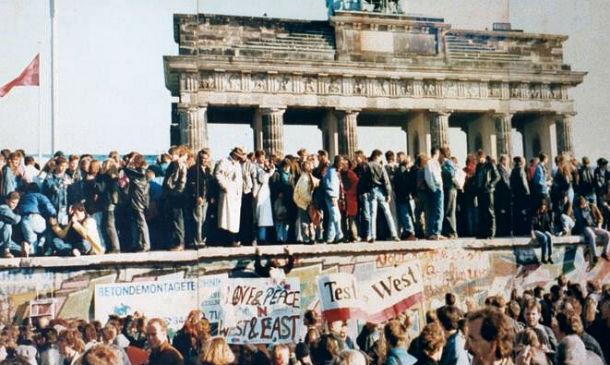
From November 9, 1989, until Christmas 1991, when the USSR declared itself closed for business, the Cold War came to a sputtering conclusion. One side won or at least declared victory. It began with an exclamation point, the crowds atop the Berlin Wall, and many revolutions in many countries unfolded over those two years before the final chapter was written. For generations before, from the late 1940s on, the Cold War was the defining fact of life for citizens in dozens of countries on the two declared sides.

For people 40 years old and older, we grew up in an era in which the end of the world was a legitimate conversation topic. The images of the happiest people on earth breaking through that terrible wall 25 years ago today are a reminder of “The Day Before,” a period when “The Day After” of our cultural imagining was unspeakable horror.

Ever since, both sides have been working hard to replicate that bipolar worldview, that us versus them mentality. It makes for an easier foreign policy, which sometimes makes for an easier domestic policy. Looking at the 25-year-old images is like getting a message from a stranger letting us know that it is still all over, but we do not know who the caller is or what is still all over.

____________________________________________
The WordPress Daily Prompt for November 9 asks, “Someone’s left you a voice mail message, but all you can make out are the last words: ‘I’m sorry. I should’ve told you months ago. Bye.’ Who is it from, and what is this about?”

* * * *
Please subscribe to The Gad About Town on Facebook: http://www.facebook.com/thegadabouttown

Clean-up in Aisle Shakespeare

There is nothing wrong with Shakespeare that couldn’t be fixed by getting rid of all the violence, and, oh! those sad endings. So many of his plays end with a pile of bodies on stage and no detective to sort it all out for us and arrest the bad guys. No one leaves the theater smiling after seeing one of those productions.

For the first few generations of critics and theater producers that followed Shakespeare, this was a common attitude. The audiences loved Shakespeare from the start, the 1590s, when his plays started to be performed in London, even if they missed some of his … finer points. There were a lot of entertaining murders, after all.

Dr. Simon Forman was a doctor and astrologer of the era who would be forgotten except he kept a diary about his day-to-day life in 1610. In it, he recounts seeing several Shakespeare plays live in production at the Globe Theater. He describes seeing “Macbeth” on April 20, 1610, in what may have been the earliest production of the tragedy. He only devotes a couple paragraphs to describing the play and crams several acts into this:

Simon Forman's diary

Simon Forman’s diary

Then was Macbeth crowned kings; and then he, for fear of Banquo, his old companion, that he should beget kings but be no king himself, he contrived the death of Banquo, and caused him to be murdered on his way as he rode. The next night, being at supper with his noble men whom he had to bid to a feast, to the which also Banquo should have come, he began to speak of noble Banquo, and to wish that he were there. And as he did thus, standing up to drink a carouse to him, the ghost of Banquo came and sat down in his chair behind him. And he, turning about to sit down again, saw the ghost of Banquo, which fronted him so, that he fell into a great passion of fear and fury, uttering many words about his murder, by which, when they hard that Banquo was murdered, they suspected Macbeth. Then MackDove fled to England to the kinges sonn, and soon they raised an army and cam to Scotland, and at Dunstonanse overthrue Macbeth. In the meantime, while MacDove was in England, Macbeth slew MackDove’s wife and children, and after in the battle MackDove slewe Macbeth. Observe also how Macbeth’s queen did rise in the night in her sleep, and walked and talked and confessed all, and the doctor noted her words.

“Macbeth” was an action movie. Did Dr. Forman notice the themes of ambition, the arrogance inside pointless ambition, or the violence that that begets? Perhaps, but the revenge plot seems to have been the shiny bauble that caught his attention.

Enter Nahum Tate to the rescue. The Poet Laureate from 1692 till his death in 1715, in 1681 he wrote “King Lear.” You may have heard of “King Lear,” but that one, the one by William Shakespeare, is too sad. Cordelia is killed, Lear carries her dead body to the stage where he then dies, every audience member with a heart is weeping, and “Who wants a snack now? Anyone?” Everyone wants to go to bed and hide under the covers. Dr. Samuel Johnson thought that Shakespeare had gone too far in killing Cordelia; it “shocked” him, he said. He preferred “The History of King Lear” by Nahum Tate.

Tate’s Lear ends with Lear killing Cordelia’s executioners and Lear’s subsequent announcement of a wedding: He is giving Cordelia’s hand in marriage to Edgar. Lear then says that he is old and will retire to die sometime soon and gives his kingdom to the newly engaged. Edgar speaks the last line: “Truth and Virtue shall at last succeed.”

Tate did not try to put across his play as Shakespeare’s; the title page of the printed edition says it was “revised with alterations” and he writes a poem of praise to his forebear:

‘Twere worth our While t’ have drawn you in this day
By a new Name to our old honest Play;
But he that did this Evenings Treat prepare
Bluntly resolv’d before-hand to declare
Your Entertainment should be most old Fare.
Yet hopes, since in rich Shakespear’s soil it grew,
‘Twill relish yet with those whose Tasts are True,
And his Ambition is to please a Few.

Shakespeare’s rich soil. He goes on to state that plays ought to teach morals:

Why shou’d these Scenes lie hid, in which we find
What may at Once divert and teach the Mind?
Morals were alwaies proper for the Stage,
But are ev’n necessary in this Age.
Poets must take the Churches Teaching Trade …

This is a perfectly reasonable aesthetic stance and one that can be argued over, but not here, not today.

For over a century, Tate’s Lear was the play that theater-goers saw when they attended a production of King Lear. In the mid-1800s, the tragic ending was restored and around that time Shakespeare’s original version became the revolutionary and new version that everyone was talking about.

In the early 1800s, Thomas Bowdler came up with an idea: an edited edition of Shakespeare. His thinking was that if Shakespeare’s plays are of value, why not make those values more obvious? His “Family Shakespeare” promised to be an edition “in which nothing is added to the original Text: but those words and expressions are omitted which cannot with propriety be read aloud in a family.” A parent or teacher could confidently place the “Family Shakespeare” in the hands of a pupil and leave them alone with it “without fear”:

From [it] the pupil may derive instruction as well as pleasure; may improve his moral principles, while he refines his taste; and without incurring the danger of being hurt with any indelicacy of expression, may learn the fate of Macbeth, that even a kingdom is dearly purchased, if virtue be the price of acquisition.

Bowdler’s version of Macbeth sounds a bit boring after Dr. Forman’s description of an action-movie Macbeth from two centuries before.

Among his edits, Bowdler changed “Out, damned spot!” to “Out, crimson spot!” and he converted Ophelia’s suicide in “Hamlet” to an accident, which gives the lie to his claim that there would be “nothing added to the original text.”

Just as Tate was ridiculed in his time yet saw his renditions of the plays become popular in their own right, Bowdler was also ridiculed in his time but saw his editions become the best known version of Shakespeare’s plays for generations.

His name became a verb: “To bowdlerize” means to clean up a famous work and make it more “family-oriented.” A hundred years later, the entry for Thomas Bowdler in the 1911 Encyclopedia Brittanica, the most famous edition of that encyclopedia, plainly states what drives bowdlerization: “false squeamishness.”

____________________________________________
The WordPress Daily Prompt for November 8 asks, “A restaurant that removed your favorite item from the menu, a bad cover of a great song … Write a post about something that should’ve been left untouched, but wasn’t. Why was the original better?”

* * * *
Please subscribe to The Gad About Town on Facebook: http://www.facebook.com/thegadabouttown

A Work of Art That Is Both and Neither

Objects do not often speak for themselves. It takes the right artist or poet to find the voice the object demands.

I wish I still possessed a copy of my one published academic paper. I remember its subject but not its point. The late Thomas M. Greene was rumored to have liked it; he may have told someone who told another who eventually (a year later) mentioned to me that he considered my work “unique.” (In academia, “unique” is not always not a back-handed compliment, and if he had been my professor he might have asked me to make it a bit less unique.) Professor Greene was an invited guest to a symposium my graduate studies department was holding; I was one of about ten speakers. My work, unique or not, was not invited to Yale, which Professor Greene called home. I was working on George Herbert and Arcimboldo, who had little to do with one another but were both looking for that moment when a work of art transcends work or art.

George Herbert was an early 17th century poet and Anglican priest, though he might have flipped that order to tell you about himself. In a handful of poems, he gives voices to objects by shaping the poems. Each word is not merely necessary for the sake of meaning, it is needed for the poem to make sense visually. In his poem, “The Altar,” each word is a stone making up the altar that the poem is conceived as being:

A broken ALTAR, Lord, thy servant rears,
Made of a heart and cemented with tears;
Whose parts are as thy hand did frame;
No workman’s tool hath touch’d the same.
A HEART alone
Is such a stone,
As nothing but
Thy pow’r doth cut.
Wherefore each part
Of my hard heart
Meets in this frame
To praise thy name.
That if I chance to hold my peace,
These stones to praise thee may not cease.
Oh, let thy blessed SACRIFICE be mine,
And sanctify this ALTAR to be thine.

One word, a single syllable, too many or one word mislaid or deleted, and there is no altar there. It is an altar made of words but no less central to the life of a church than an altar made of stone. The poem appears in the only book of poems that he compiled himself, a book titled “The Temple,” which walks the reader, a “dejected poor soul,” through a church. Thus, the altar, “The Altar,” is central.

In later eras, poems like this came to be called shape or pattern or emblem poems. They are sometimes used to get elementary school students interested in, captivated by, poetry, the potential playfulness and the playful potentials of poetry. “The Altar” is not one of those poems given to elementary school kids with that playful ambition.

It is an altar, however. A “broken altar,” because words are shards of meaning like pieces of stone fitted together to make the church structure. A heart is the only perfect, unbroken, stone for worship, is the only true altar. But all that his heart can make is something out of these pieces of meaning, words, and if he can get out of his own way (“if I chance to hold my peace”), these words as assembled here only exist to worship and love. They are what they are, words, and the words each on their own are not an altar, and a spoken version of this poem is not an altar, either. When is an altar an altar? At what point is a poem something other than, more than, words on a page?

Printed on the page (or screen), it is an altar for Herbert’s church in book form. “The Temple” is like a 17th Century pop-up book for Anglican communicants.

Just before Herbert was writing his worshipful shape poems, an Italian painter named Guiseppe Arcimboldo was working in Milan. Arcimboldo died the year Herbert was born, 1593, and it is extremely unlikely Herbert ever heard of or saw replicas of Arcimboldo’s paintings. He may have understood them better than many contemporaries—by 1633, the year of Herbert’s death, Arcimboldo was already a forgotten figure in art, out of style, passé.

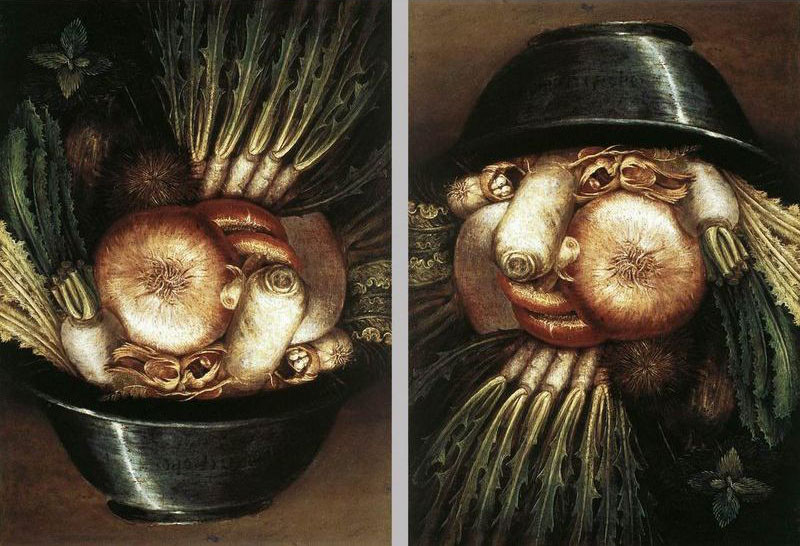
Arcimboldo openly toys with the conceit that what one is looking at is the thing it is depicting. His subject as an artist is the idea that a painting is only a painting and that you the viewer really do most of the work of “believing” that one is looking at something, some thing. This idea is similar to Herbert’s altar of words serving as an idea of an altar and as an altar at the same time.

When is a face a face and when is it a bowl of root vegetables? When is a painting a painting and something greater than a collection of chemicals on canvas?

Vegetables In A Bowl, Or, The Gardener

As with Herbert’s “Altar,” one word, one vegetable, too many or one item mislaid, and there is no face there. It is as carefully assembled as all works of art that appear to be casually thrown together are. If only he had included the actual vegetables in the paints he used …

The Surrealists rediscovered Arcimboldo for themselves in the 1920s and ’30s, and his paintings have been popular ever since. Herbert never went out of fashion, because he was never a fashion. They are each the most humble of flashy artists, taking themselves out (“hold my peace”) of the way in the name of depicting an idea about ideas. An idea that was revolutionary in the 20th Century, that art did and did not depict anything and was its own thing, had precursors centuries earlier. A gardener is his vegetables, an altar has a worshipful voice; art is self-conscious in its forgetting of self.

____________________________________________
The WordPress Daily Prompt for November 7 asks, Yesterday, your pet/baby/inanimate object could read your post. Today, they can write back (thanks for the suggestion, lifelessons!). Write a post from their point of view (or just pick any non-verbal creature/object).”

* * * *
Please subscribe to The Gad About Town on Facebook: http://www.facebook.com/thegadabouttown