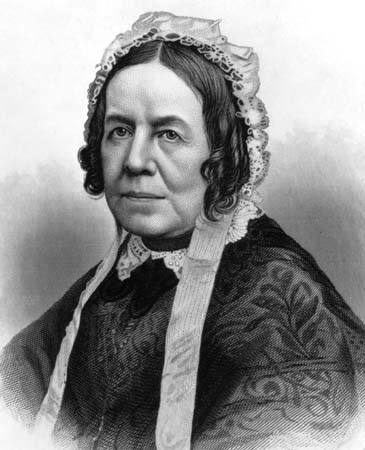
In most of her portraits, Sarah Josepha Buell Hale, the reason we celebrate Thanksgiving, looks stern. Gentle, but stern. She was an editor, but befitting a woman of her era, she employed the term, “editress.” From age 33 until her death at age 90, she wore black, to designate her as a widow in mourning from the day her husband died until the day she was to join him.
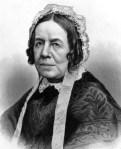
Sarah Hale
Hale was the editor (“editress”) of Godey’s Lady’s Book, a pre-Civil War monthly magazine that sometimes topped 100,000 in circulation. She held the job for forty years, retiring in 1877 when she was almost 90. Her legacy as editor is a mixed one: she wrote and published articles in favor of advanced education and employment opportunities for women but her publication (and she) did not support women voting.
Gentle, but stern; she was anti-slavery and pro-North and pro-Union (she was a New Englander) but anti-war. Her point of view was that women writers wrote for women and for children.

Sarah Hale, 1831
Indeed, earlier in her career she wrote poetry for children, and one of her poems is a work so famous that it is surprising to learn that a human being wrote it: “Mary Had a Little Lamb.” Around that time, her portrait was painted by James Lambdin (no relation to Mary’s pet), an artist who painted two U.S. Presidents who were also among the first photographed. The verisimilitude of his portraits is borne out by the photos, so his portrait of young Sarah Hale, already in mourning black, must be true to life as well. Gentle, but serious.
When the idea of a campaign for a national Thanksgiving holiday came to her, she became relentless about it and marshaled all her resources. She was already a successful fundraiser and had organized supporters to see the Bunker Hill Monument completed. She was one of the founders of Vassar College. As with those causes and campaigns, Hale knew that persistence would win, eventually.
Thanksgiving days and harvest days are common around the world, but it was always a grab-bag and a movable feast in America. The Spanish settlers in St. Augustine, Florida, are believed to have held a celebration feast with the local Native Americans in September 1565. Up the coast, the first Pilgrim Thanksgiving in 1621, or later, was probably in September, also.
There is no way to separate fact from legend about the Pilgrim Thanksgiving, the one said to have been celebrated by Pilgrims and Native Americans in 1621 at Plymouth Plantation, but it is known that by 1630 Massachusetts Bay Colony was celebrating its own Thanksgiving. (The Pilgrims and the Puritans who were building Massachusetts Bay Colony were not friends, even though both groups were made of Calvinists who did not find the Anglican Church strict enough.)
(The Pilgrim William Bradford’s famous journal, “Of Plymouth Plantation,” which covers the years from around 1630 to 1650, recounts that first Thanksgiving and is a source of imagery for our collective cultural memory of that day, but it vanished during the Revolutionary War and was not found or generally known about until 1897. It is essentially a twentieth century document re-affirming what we were telling ourselves about ourselves.)
During the Revolutionary War, the Continental Congress proclaimed several Thanksgiving Days, usually after a military victory, and various colonies created their own traditions. In some years, the first few presidents (but not Jefferson) issued national proclamations of a Thanksgiving day, but in some years they did not. Various states created their own traditions. Many of the states in the American South did not.
For two decades, Sarah Josepha Hale wrote letters advocating a national Thanksgiving Day. It is her work in this matter that gives us our annual tradition. Her letters reached five presidents: Taylor, Fillmore, Pierce, Buchanan, and Lincoln. (The letter to Lincoln is shown at top.) Finally Lincoln’s administration saw the brilliance of having a national day of thanksgiving: The Civil War was going to end sooner or later and the nation, north and south or only the north alone, was going to need unifying sentiments, a healing reminder of gratitude, even a new national holiday that was not of the north or the south in its mythology but newly created for the more strongly united United States of America.
The first modern Thanksgiving was proclaimed for that year, 1863, and it has been a national holiday since. Hale was 74 years old.
Lincoln’s proclamation, dated October 3, 1863, reads:
The year that is drawing towards its close, has been filled with the blessings of fruitful fields and healthful skies. To these bounties, which are so constantly enjoyed that we are prone to forget the source from which they come, others have been added, which are of so extraordinary a nature, that they cannot fail to penetrate and soften even the heart which is habitually insensible to the ever watchful providence of Almighty God. In the midst of a civil war of unequalled magnitude and severity, which has sometimes seemed to foreign States to invite and to provoke their aggression, peace has been preserved with all nations, order has been maintained, the laws have been respected and obeyed, and harmony has prevailed everywhere except in the theatre of military conflict; while that theatre has been greatly contracted by the advancing armies and navies of the Union. Needful diversions of wealth and of strength from the fields of peaceful industry to the national defence, have not arrested the plough, the shuttle, or the ship; the axe had enlarged the borders of our settlements, and the mines, as well of iron and coal as of the precious metals, have yielded even more abundantly than heretofore. Population has steadily increased, notwithstanding the waste that has been made in the camp, the siege and the battle-field; and the country, rejoicing in the consciousness of augmented strength and vigor, is permitted to expect continuance of years, with large increase of freedom.
No human counsel hath devised nor hath any mortal hand worked out these great things. They are the gracious gifts of the Most High God, who, while dealing with us in anger for our sins, hath nevertheless remembered mercy.
It has seemed to me fit and proper that they should be solemnly, reverently and gratefully acknowledged as with one heart and voice by the whole American people. I do therefore invite my fellow citizens in every part of the United States, and also those who are at sea and those who are sojourning in foreign lands, to set apart and observe the last Thursday of November next, as a day of Thanksgiving and Praise to our beneficent Father who dwelleth in the Heavens. And I recommend to them that while offering up the ascriptions justly due to Him for such singular deliverances and blessings, they do also, with humble penitence for our national perverseness and disobedience, commend to his tender care all those who have become widows, orphans, mourners or sufferers in the lamentable civil strife in which we are unavoidably engaged, and fervently implore the interposition of the Almighty Hand to heal the wounds of the nation and to restore it as soon as may be consistent with the Divine purposes to the full enjoyment of peace, harmony, tranquility and Union.
In testimony whereof, I have hereunto set my hand, and caused the seal of the United States to be affixed.
Done at the city of Washington, this third day of October, in the year of our Lord one thousand eight hundred and sixty-three, and of the independence of the United States the eighty-eighth.
Stern, but gentle.
____________________________________________
The WordPress Daily Prompt for November 27 asks, “Is there a person you should’ve thanked, but never had the chance? Is there someone who helped you along the way without even realizing it? Here’s your chance to express your belated gratitude.”
* * * *
Please subscribe to The Gad About Town on Facebook: http://www.facebook.com/thegadabouttown
41.401884
-74.321252
Thank you for sharing this via one of these wonderful services:
 When one achieves 1337 of anything on a website, it is worth noting because 1337 is a lot of anything. In the case of The Gad About Town, it reached 1337 likes on November 26, when someone liked the column, “Gratitude Week.” In old-school hacker lingo, being an elite member of the community was designated by referring to them as elite, or a leet, or 1337. Again it’s the upside-down calculators that I have never looked at without saying, “What?”

 The Gad About Town