Wherever You Go, There You Weren’t

In recovery circles it is called, “pulling a geographic.” While sharing their stories about the past and living the inebriated life, many addicts and alcoholics learn that they have done similar things. (Although I am the only person I know of who stole a commuter train. For only five feet, but still. Sorry, Metro-North.)

One of the things that many of us did a lot of when we were trying to exert control over life was run from it. Move. Sometimes cross-country. There was nothing so bad it couldn’t be fixed without filling out a change-of-address card.

Some might call this “running away from one’s troubles,” and those “some” people would be correct, somewhat. At the time, I did not see things that way. I was taking advantage of new opportunities. And now, I am grateful for all that I have seen; as I have written somewhere, if I am content-verging-on-happy about life now, how can I resent my past? I hate some things that happened to me, some things that were done to me and some things I did, but I no longer yell at ghosts. (Understand, my life is pretty not-entangled, given that I do not yet have children.)

By the oldest of old-fashioned reckoning, counting on my fingers, I have resided at more than 20 addresses in six counties across three states in two time zones. (This includes three residences in four-and-a-half years in recovery.) And there are about a half-a-dozen “I almost lived there” cities that sit in my memory like books unread on a shelf in a library I no longer have a membership card to. Two suburbs of Boston, Massachusetts; Jersey City, New Jersey; Sheboygan, Wisconsin; Nashville, Tennessee.

Each one of those place-names sounds to me like a bullet whistling past my head, an anecdote of a disaster that I did not have to watch unfold in front of my eyes as if I was a bystander in my life instead of a participant. I had enough disasters in the places in which I resided; and, yes, I might have found recovery in any one of those fine cities and be celebrating many more years of recovery than I have, but I did not. Life is perfect where I reside, even in its many imperfections.

Oh! and California. I had a few job interviews with newspapers in the Bay Area. It was the late 1990s and several friends and acquaintances had moved to the Golden State. (Matt Coleman, Some Memories.) By the late 1990s, several had moved back to New York, of course, but not all. I have yet to set foot west of Sedona, Arizona.

Wherever I moved, the fact of successfully landing a new job, which was always the spur for any change in residence for me, carried with it the idea that I was a success in this life and had no problems ticking away in my psyche. “Sometimes sooner, sometimes later,” as the saying goes, this hubris that masqueraded as self-knowledge always resulted in the loss of employment, change of address, loss of friends.

(I never consumed on the job. I always drank off the clock. But at some point, those two facts will be over-ridden by how much one consumes off the clock and how little one produces on the job. An illustration of the progression of addiction: I liked to drink as a celebration of successes. I worked hard and earned it, went the thinking. Publish something? Go out, get congratulations from people, drink. Finish writing something? Okay, great, you’ll submit it tomorrow. Go out, get congratulations from people, drink. Get pretty far into an assignment? It’s late, you’ll get it done tomorrow. Go out, congratulate people, drink. Start something? Cool. Go out, con … people, drink. Button your shirt correctly on the first try? Drink alone. Go out tomor … soon.)

You know, I never fooled myself into believing that I was indispensable, but did I have to prove it so often?

Wherever I went, there I wasn’t, completely. Four-and-a-half years off that hamster wheel, and I feel like I can make it anywhere.

____________________________________________
The WordPress Daily Prompt for December 5 asks, “‘If I can make it there, I’ll make it anywhere,’ goes the famous song about New York City. Is there a place—a city, a school, a company—about which you think (or thought) the same? Tell us why, and if you ever tried to prove that claim.”

* * * *
Please subscribe to The Gad About Town on Facebook: http://www.facebook.com/thegadabouttown

Mea cuppa

One of my superpowers is breaking things.

Now, I know that anyone can break anything with enough gumption and/or strength. At best, it is an inadvertent superpower; at worst, it is doom for the planet. I am not certain that I can not break paper.

I learned that I have this superpower the hard way: By claiming that I do not have it. I no longer remember what point I was trying to illustrate when I said to a group, “Nothing’s unbreakable. Right? Who hasn’t broken a so-called ‘unbreakable’ comb?” Perhaps I was talking with a group of fancy people who don’t buy their combs at convenience stores or truck stops, but I had had the experience of buying and later snapping in half a comb that had “unbreakable” written right on it. In. Capital. Letters.

Like some of you, no one in the group knew what I was talking about. Each one’s experience with combing his or her hair with an unbreakable comb was only as described on the tools themselves. Bendy, yes. Twisty, uh-huh. Breaky? Just me.

I once broke a Livestrong bracelet. What was I trying to do with it? Put it on my wrist. It snapped and flew across the room.

A few weeks ago, I was cooking. It happens. I was cooking something in a Pyrex pan in the oven, which is something I should not do. I have metal pans and, usually, common sense. I had a Pyrex pan in the oven, and when the dish was done, I removed it from the oven. (Most cookbooks describe this part, which is the most exciting after all, very blandly. “Remove dish from oven.” It’s the single most exciting part of the cooking experience! Whatever the opposite of overkill is, that right there is an example.)

I moved the food onto my plate and carried the Pyrex back into the kitchen. And then, because I do not think things through, I placed the thick glass cookware in the sink …

(Did you know that not all Pyrex is the same? (Thanks, online world of information.) Corning divested itself of its consumer goods division 16 years ago and licensed the name “Pyrex” to other companies, some of which use a different formula from Corning’s classic recipe, and thus produce glassware that is sometimes not as heat-resistant as Corning’s original. Of course, “heat-resistant” was always something of the point to Pyrex, so this is just terrific. If you see a Pyrex product with the red logo “PYREX” in all caps, that product is one that was made by Corning with the original formula and is stronger. The other logos are the newer products, which are not knock-offs precisely, as Corning did grant those companies licenses, but they are not made following the same formula.)

… I placed the heat-resistant glassware in the sink and hit the faucet. In a split-second, I remembered that objects right out of a hot oven react violently to cold water and I twisted the faucet back off. One drop of water (no exaggeration) left the faucet. When it hit the Pyrex, my sink was suddenly filled with shards of glass. Some of the shards were as big as a finger, let’s say someone’s middle finger, but most were smaller. Oh, and steam.

So I break things. Things that were invented because they are less likely to break.

With great power comes great responsibility, so what am I doing making my morning coffee in a press? (A fine example of which, not my personal one, is seen above.)

The French press “is essentially open-pot coffee with a sexy method for separating the grounds from the brew. The pot is a narrow glass cylinder. A fine-meshed screen plunger fits tightly inside the cylinder; you put a fine-ground coffee in the cylinder, pour boiling water over it, and insert the plunger in the top of the cylinder without pushing it down. After about four minutes the coffee will be thoroughly steeped and you push the plunger through the coffee, clarifying it and forcing the grounds to the bottom of the pot. You serve the coffee directly from the cylinder. Be certain not to use too fine a grind unless you have an athlete or a weightlifter at the table; the plunger will be almost impossible to push down through the coffee.” This is from Kenneth Davids’ classic book, “Coffee: A Guide to Buying, Brewing, and Enjoying,” and my quote is from the 1981 edition. His more recent edition changes the ground to “coarse-to-medium,” the water from boiling to “just short of boiling,” and loses the weightlifter joke. Oh, and “sexy” is changed to “sophisticated.” Too bad.

He goes on, “The plunger pot was apparently developed in Italy during the 1930s, but found its true home in France after World War II, when it surged to prominence as a favored home-brewing method.” That is why, when I first saw one in a friend’s kitchen, I asked if the thing was a “French” press. I knew that much, I guess. I also asked where one turned it on. She didn’t stop laughing long enough to tell me.

After two years of making coffee with one of these, I have broken two so far. Because that is what I do.

____________________________________________
The WordPress Daily Prompt for December 4 asks, “If your furniture, appliances, and other inanimate objects at home had feelings and emotions, to which item would you owe the biggest apology?”

* * * *
Please subscribe to The Gad About Town on Facebook: http://www.facebook.com/thegadabouttown
My Thinking Makes It So

In Act 2, Scene 2, of Hamlet, the doomed Rosencrantz and Guildenstern are chatting with the prince. They are old college buddies of Hamlet’s, and King Claudius (Hamlet’s step-father) and Queen Gertrude (his mother) have sent for them to learn what is bothering the young man, who has been acting with an “antic disposition” and saying strange things, half to himself and half to no one can tell who.

Hamlet greets them and speaks in the same riddling manner that he has been using with the rest:

HAMLET: Let me question more in particular, my good friends, what you have done to deserve such fortune, that she sends you to prison hither?
GUILDENSTERN: Prison, my lord?
HAMLET: Denmark’s a prison.
ROSENCRANTZ: Then the world is one.
HAMLET: A goodly one; in which there are many confines, wards, and dungeons, Denmark being one o’ the worst.
ROSENCRANTZ: We don’t think so, my lord.
HAMLET: Why, then ’tis none to you; for there is nothing either good or bad but thinking makes it so. To me it is a prison.

Hamlet quickly determines that they are not merely dropping in to talk about sports and the weather but are spies. Ultimately, he manages to have them both killed.

Shakespeare’s quip about how one’s thinking determines a thing’s relative goodness or badness has lived on through the centuries, but in most peoples’ recitations it carries about the same weight now as a Twittering teenager’s hashtagging of “YOLO.” Perhaps this is because it is delivered by a character who is speaking in riddles and jests and pretending to be mad. (“What are you reading?” “Words, words, words.”)

Four hundred years after Hamlet was first performed, “Nothing (is) either good or bad but thinking makes it so” is spoken as a longer, more profound-sounding, version of, “Don’t sweat the small stuff.” “The rain is uncomfortable for you but it’s good news for the farmers,” says the profound thinker who apparently wants me to punch him. (I once replied to this with a “Do you know any farmers? We live in the suburbs. If you do, see if they’re carrying umbrellas, too.” The person walked away, which of course was the only proper reply to my being a jerk.) (We are still friends. I have my good points.)

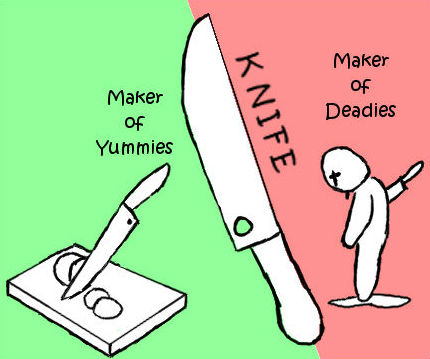
knifeconstrastMany people resist strongly and vocally when it is suggested that, taken existentially, Shakespeare and/or Hamlet is right. Our perception is all that defines good from bad. A happy event, in and of itself, is not inherently a good thing. A tragic happening is not by definition evil. There is a deep commitment to the idea that there is evil in the universe as well as good; that good inheres in things we like and love and that evil is a containable reality. This is because most of us combine and conflate the notions of sad with bad and happy with good.

Some of the saddest things that I have seen have had positive things follow them, possibly as a result of reactions to the sad thing. (I am disabled and that sucks, and I would not wish the experience on people I dislike, but being disabled gives me an income, a teeny-tiny one, which gives me time to write; a small example, that, but reality resides on a spectrum and not in an either-or zero-sum playhouse.) And some of the best things that I think I have done may turn out to have terrible consequences. Sadness exists. Tragedy is a reality. So is happiness.

Are there people who do wrong in this world? People who introduce sadness into peoples’ lives or who work for their own personal gain to the detriment of others around them? Of course. Hamlet was no murderer but he had Rosencrantz and Guildenstern killed. (Fictional characters, of course.) Hitler existed. If evil is inexplicable, well, then, so is good. We want all matters to be explicable, however, so we deploy terms like “good” and “evil” as if they are tools that explicate.

Further, our minds want there to be someone to credit or something to blame behind the good or the evil thing. There must be an explanation, goes the thinking. Thus, there must be a find-able motivation animating even the explicably good thing or evil person. The great journalist Ron Rosenbaum explores this in his famous book, “Explaining Hitler,” which confronts the book buyer from the start, the front cover. Hitler’s baby picture sits there. Historians have searched for decades for the clues to pinpoint the moment baby Adolf became Hitler. What was the cause? The explanation? It seems that it is not okay if there is not one. But “here there is no why,” as Martin Amis writes of Auschwitz.

Rosenbaum interviewed Alan Bullock, one of Hitler’s biographers. “‘Some days, I ask God,’ Bullock told me, his voice dropping to an impassioned whisper, ‘If You were there, why didn’t You stop it?’ And then he added the sad lesson of a lifetime spent attempting to explain Hitler: ‘Never believe God is omnipotent.'”

Boom! Is the Holocaust, or a holocaust, a man-made political rampage, something so far outside human imagination when it is always and only the product of human imagination?

Yehuda Bauer, a Holocaust Studies scholar, replies to Rosenbaum’s question, “Will there ever be a why?” “Bauer told me that he believes it is theoretically possible. ‘But the fact that something is explicable doesn’t say that we have explained it.'”

Terrible acts and tragedies are the horrible outliers of most human experiences. The beautiful thing is that love, great love and small love, is not. And it is just as inexplicable … until I gaze in my beloved’s eyes.

____________________________________________
The WordPress Daily Prompt for December 3 asks, “What’s the best piece of advice you’ve ever received that you wouldn’t give to anyone else? Why don’t you think it would apply to others?”

* * * *
Please subscribe to The Gad About Town on Facebook: http://www.facebook.com/thegadabouttown