A Farce in Egypt

The judge “bellowed” the verdict against the three journalists today, according to reports. He announced that the three were found guilty and sentenced them to three years in jail. Mohamed Fahmy, Baher Mohamed, and Peter Greste already spent more than 400 days in prison in Egypt after being arrested for “spreading false news” while working for al-Jazeera English.

The three have already been convicted, retried, acquitted, retried again. Greste, an Australian, was deported last year.

Judge Hassan Farid declared today that the court had determined that the defendants are not journalists as they are not members of Egypt’s “Journalists Syndicate,” nor had they registered with a national agency that grants foreign reporters permits to work in the country. Thus, since they are not officially journalists, they were working against the government. They had been convicted in a first trial in 2014, sentenced to seven years in prison each, retried, acquitted, retried again, and convicted again today. Another retrial is being worked on but the earliest it can start is 2016.
Read More
The Myth of ‘The Other’

[He] sees the fate of conspiracy in apocalyptic terms—he traffics in the birth and death of whole worlds, whole political orders, whole systems of human values. He is always manning the barricades of civilization. He constantly lives at a turning point. Like religious millennialists he expresses the anxiety of those who are living through the last days and he is sometimes disposed to set a date for the apocalypse. … As a member of the avant-garde who is capable of perceiving the conspiracy before it is fully obvious to an as yet unaroused public, [he] is a militant leader. He does not see social conflict as something to be mediated and compromised, in the manner of the working politician. Since what is at stake is always a conflict between absolute good and absolute evil, what is necessary is not compromise but the will to fight things out to a finish.—Richard Hofstadter, Harper’s Magazine

The above passage was not written recently. It does not describe anyone in the news right now. It was written in 1964 and published the month of the Presidential election that year. Its title is “The Paranoid Style in American Politics.” Hofstadter was an historian who found himself concerned with the angry political rhetoric that was emerging that year and re-discovered that there was little new to it, that in fact a “style” of rhetoric could be identified that regularly emerged and re-emerged in our history.

The “paranoid style” is back this year in America.
Read More

Tortured

This column was revisited one year later, in August 2016, here: “One Year Ago: A Public Torture.”

* * * *
The cane broke. Isn’t that all we need to know? The switch broke.

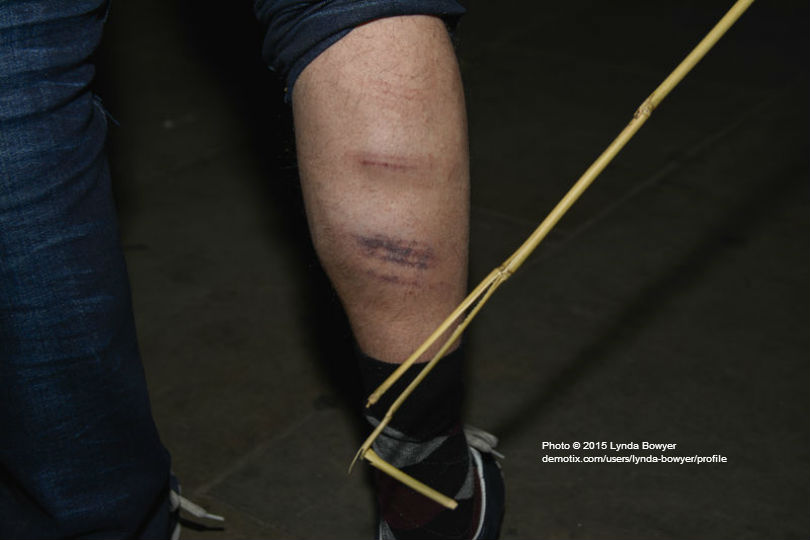
Raymond Johansen allowed himself to be tortured yesterday in solidarity with Saudi writer Raif Badawi. He was hit 50 times with a cane in Trafalgar Square, where public corporal punishments were once seen regularly but not since the 1830s. He had difficulty walking after and even expressed confusion as to where he was upon speaking with a reporter.

When a caning is administered it sometimes does not look as severe as one thinks a beating would look; even one of the words we use minimizes the severity: lashes. In writing about the Saudi Arabian writer Raif Badawi, who was sentenced last year to 1000 lashes and 10 years in prison, I have run into this weakness of language. All language is analogy, and I have wanted the analogy to convey the pain of judicial corporal punishment. Few do. Perhaps none do. Raymond Johansen’s action pumped life into the analogies.
Read More