
#OpParis: The Fight Is On

Whatever else ISIS, ISIL, Daesh may be—a group of religious fundamentalists, general terrorists, people with an ambition to become religious despots—it is at the moment a community. A dangerous community.

In religion, its members may be pre-medieval (which is almost an insult to the pre-medieval era), but Daesh’s members take full advantage of the many tools our current, plugged-in era offers: inexpensive smart phones and global cell phone coverage, ubiquitous Wi-Fi, and the dozens if not hundreds of social media platforms one can use to declaim ideology, assert ambitions, cheer each other on while pursuing bargain prices on new weapons purchases. Daesh’s members publish blogs, Tweet, own Facebook and VK accounts, put homemade videos on YouTube and elsewhere. There are other individuals out there who may not share in the religion-based hatred but who love violence and carnage, so they join in the online noise and learn what they can do to support the spread of religious bloodshed.

Who could possibly help separate the chatter from the actionable intelligence? Who could possibly thwart the next Paris-style, multiple-front attack? Who could possibly make it more difficult for Daesh members to communicate with one another, without looking like a government was doing the snooping? Is there anyone out there who can step up and be our assh*les for freedom?

Yes. Before dawn this morning, this announcement from a portion of the hacktivist group Anonymous appeared on Twitter:
Read More
Ali al-Nimr: A Chilling Update

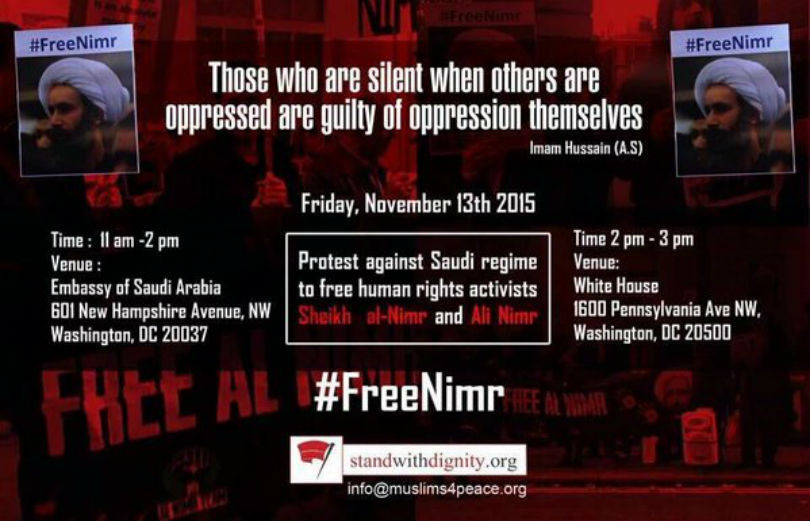
It was confirmed this week that the conviction of and death sentence for Mohammad Suwaymil was upheld in a Saudi appeals court this month. He is one of seven individuals arrested for protest in Saudi Arabia—including Ali Mohammed al-Nimr—and his case was the last one against the seven that had not been heard all the way through the appeals process; with that announcement, reports came out from some of the prisoners’ families that conditions have been made even worse for each of the seven.

Whether or not any of them know what has transpired in Saudi Arabia’s legal system, whether or not any of them know they are being treated as a group inside that legal system, each man seems to know that a horrible end is now within sight. By the time you read this, these seven men: Sheikh Nimr Baqir al-Nimr, Ali Saed Al-rebeh, Mohammed Faisal al-shyookh, Dawood al-Marhoon, Abed allahhassan al-Zaher, Ali Mohammad al-Nimr, and Mohammad Suwaymil, may already have been beheaded and their dead bodies put on display, crucified.
Read More

A Bloodthirsty System

In a police state, the presumption is that if one is arrested, one has done wrong. No defense can be mounted for a person who stands accused in a system that is as divorced from logic, grants no respect to human decency, lacks human rights as one that assumes an accusation is the same thing as guilt.

Police states force anyone accused of a crime to mount an argument against the logic that makes arguing a crime. It is also common for justice systems in police states to keep the accused wondering what exactly they have been charged with or will be charged with, which makes mounting an appropriate or effective defense almost impossible. Important matters like evidence or the lack of evidence are rendered moot.

Saudi Arabia is only one such nation; there are others, certainly.

The case of Ali Mohammed al-Nimr in Saudi Arabia has attracted much attention in recent months, in this website and elsewhere. The young man was arrested at a protest and charged with so many crimes of such scale and scope that it would be comically impossible for one person to have committed them. He was arrested as a youth and treated as an adult, which flouts international conventions. Nonetheless, Ali was convicted and sentenced to die by public beheading; furthermore, after the beheading, his body is to be publicly displayed, crucified, to show him, to show others like him, to show the world … well, what exactly? I do not know.
Read More