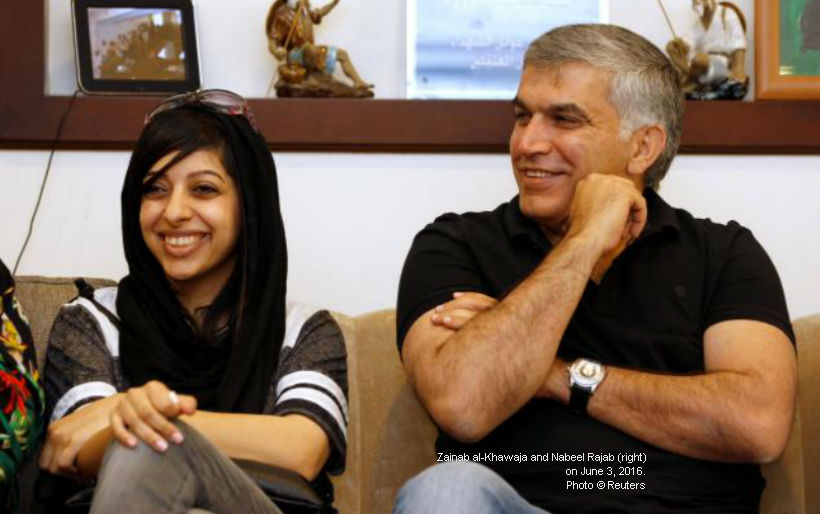
An Appalling Arrest in Bahrain

When Nabeel Rajab, the president of the Bahrain Center for Human Rights, was arrested earlier today, he asked the plainclothes police officers who had spent the previous half-hour searching his house and confiscating his cellphone and other electronic devices why they were arresting him.

“We don’t know,” he was told, according to an RT interview with Rajab’s wife Sumaya. “We don’t know, but we have been ordered to do so.” And they took him away. Thirty officers were involved in the raid and arrest, which is believed was led by Bahrain’s Cybercrime Unit.

The arrest comes on the same day that the United Nations Human Rights Council opened its 32nd session in Geneva, Switzerland. Yesterday, six Bahrain human rights activists were prevented from boarding flights from Bahrain to travel to the UNHRC sessions. Bahrain has long employed that tactic of repression: forbidding activists from leaving the country to tell the world what is happening behind closed borders.
Read More

The Endless Wait Continues for Shawkan

The trial of the 739 defendants on trial for a variety of charges related to the “Rabaa sit-in,” a case that includes the photojournalist Shawkan, got underway today in Cairo. At the conclusion of the proceedings, it was announced that the next hearing will be conducted on June 28. The day unfolded with a few moments of chaos.

When a court case involves more than 700 co-defendants, perhaps one should expect some chaos. This morning in Cairo, Egypt, the latest hearing in the trial of the Rabaa sit-in defendants, erupted into shouting and a judge who claimed that if he did not see something himself in his courtroom, it did not take place.
Read More

Free Dawit Isaak

“We will not have any trial and we will not free him. We know how to handle his kind.”
Isaias Afwerki, President of Eritrea, speaking in 2009 about writer Dawit Isaak

The last time Amnesty International mentioned the case of the imprisoned Eritrean writer Dawit Isaak, it was in its 2011 annual report about Eritrea. Amnesty reported what it believed to be safe to report: that Isaak “remained in detention, allegedly in Eiraeiro Prison. He was reportedly in poor mental and physical health.”
Read More