‘I’m in prison because I was doing my job’

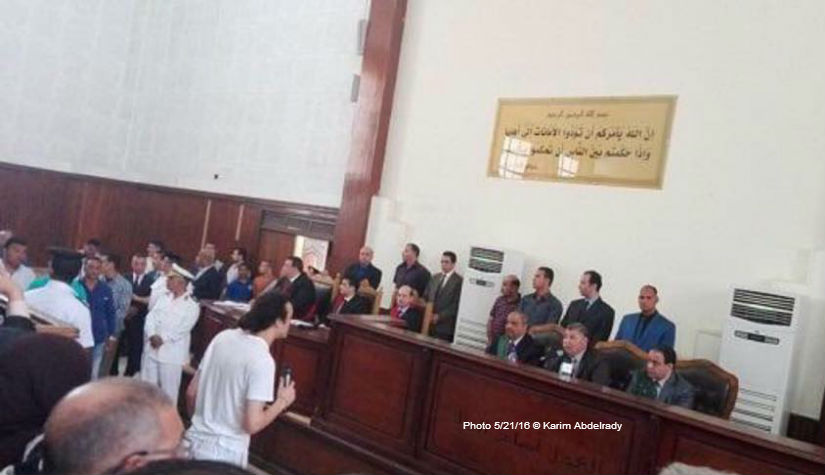
Mahmoud Abou Zeid, the Egyptian photographer known as Shawkan, had an opportunity to speak on his own behalf in court today. He is the individual in white holding a microphone and addressing the panel of judges in the above photo. Shawkan’s case was postponed, yet again, this time until May 31.

“I’m in prison because I was doing my job,” Shawkan told the court. Today was the first time that Shawkan was able to address the court. Shawkan was arrested more than 1000 days ago while covering a protest—the Rabaa sit-in—that was a part of Egypt’s portion of demonstrations during the vast Arab Spring movement. He was arrested in a round-up of hundreds of people, and as a result, he is one of more than 700 co-defendants awaiting the start of his trial.

President al-Sisi’s government (and its jurisprudential system) has made it clear that it considers that job, journalism, to be a criminal enterprise. Several dozen are in jail in that nation right now; to the best of my knowledge, Shawkan has been held the longest: 1011 days today.

In the video below the fold, Shawkan speaks with the judges. At one point, he gestures toward the television and news cameras as if to say, “I should be with them covering hearings like this.”
Read More
Shawkan’s Journey Through Injustice

The delays are growing shorter. The latest delay in photographer Mahmoud Abu Zeid’s journey through Egypt’s justice system was announced today: four days. The start of his trial has once again been re-scheduled, this time from today to May 21. This is the sixth delay since the end of 2015.

Egypt has been much in the news lately, so a delay in one case of injustice may not attract the attention it deserves. It was confirmed today that U.S. Secretary of State John Kerry will be in Cairo tomorrow for talks with Egypt’s president, Abdel Fattah el-Sisi. It also comes after two courts sentenced 152 people to between two and five years in prison on Sunday for participating in peaceful protests last month. They were not convicted of vague charges like “inciting violence,” though that was in the mix; they were all found guilty of protesting, something that has been illegal in Egypt since 2013.

That news has taken much of the attention away from the story of one photographer, Mahmoud Abu Zeid, known professionally as Shawkan. But it may predict some possible outcomes for Shawkan, none of them happy. President al-Sisi’s government is willing to find people guilty of peaceful protest, and it now has the apparatus in place to handle large numbers of defendants, which is what a government confronts its justice system with when it makes mass arrests at protests a standard practice, a policy. Both circumstances will come to bear on Shawkan’s story and it may be why this latest delay is for only four days.

Shawkan was arrested more than 1000 days ago while covering a protest that was not peaceful, that was a part of the vast demonstrations that one could say were a part of the ongoing Arab Spring movement. He is one of more than 700 co-defendants awaiting the start of his trial.
Read More

From Inside a Cage

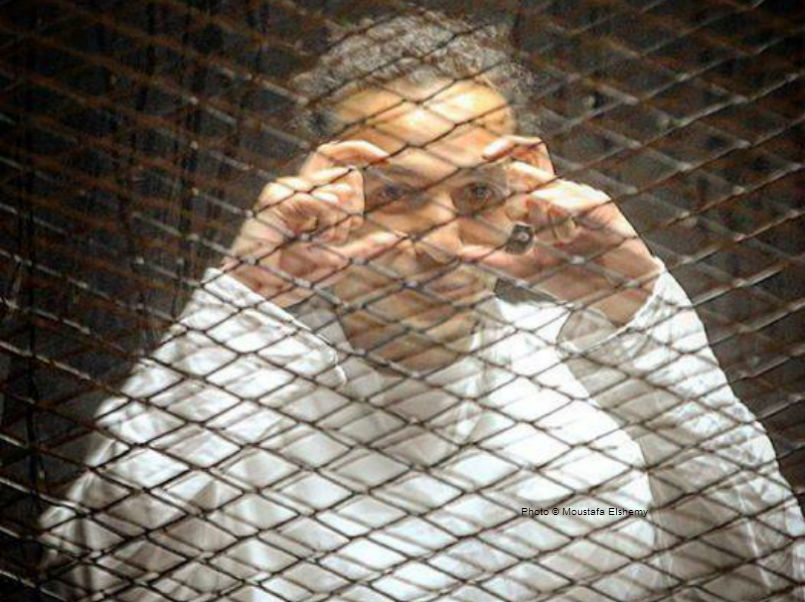
From inside the courtroom cage in which he and many other defendants were held, the photographer Mahmoud Abu Zeid, also known as Shawkan, started posing as a photographer for his friends in the courtroom earlier today. In the photo at top, it looks like he is snapping shots with an Instamatic; in others he imitates holding up a heavy telephoto lens.

Today brought Shawkan to one more hearing, one more in long line of hearings in which the Egyptian court system has repeatedly postponed starting to hold hearings. Thus, once again, it was announced from the bench today that the trial start would be postponed yet again until May 17, one week. It is a Kafka-esque farce, minus any deeper meaning.

Shawkan is one of more than 700 defendants. Taher Abu el-Nasr, a lawyer affiliated with the case, told the Cairo Post last month that he expects the trial to take a long time until a verdict is issued due to the huge number of defendants: “it might take the court 20-30 sessions to only hear the prosecution witnesses; this is something annoying and exhausting to everyone.”
Read More