Philip Larkin, born one-hundred years ago today, was a librarian at the University of Hull in the north of England. Some may celebrate him for that job—he was a great librarian and administrator and oversaw the library’s expansion—but most celebrate him for his poetry.
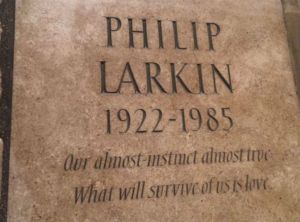
He was a major poet; thirty-seven years after his death, he is consistently ranked among the top ten post-war English writers by other writers. His name tops most contemporary polls as Britain’s favorite poet. Many of his lines live on in our hearts and memes: “Our almost-instinct almost true: / What will survive of us is love,” from “An Arundel Tomb” is quoted on his plaque in Poets’ Corner in Westminster Abbey:
Born in Coventry, he studied at Oxford University and became best friends with Kingsley Amis and Robert Conquest; he contributed to and helped edit Amis’ first novel, Lucky Jim, which launched Amis on his own career in literature.
In 1955 Larkin accepted the position at Hull, far away from the London literary scene, and he never left. He rarely saw London or Oxford, even more rarely spent time abroad, never set foot in Canada or America. His summer vacations were usually further north from Hull: annual summer weeks with one girlfriend, Monica Jones, at her cottage in Haydon Bridge in Northumberland, other trips to Scotland. Even his lifelong friendship with Amis was a largely epistolary one: at Larkin’s funeral in 1985 near Hull, Amis was heard to mutter more than once, “Why have I never been here?”
In 1964, a television program profiled Larkin, who had by then published two novels and three volumes of poetry and was already ranked among the best writers of his generation. Asked about his affiliation with Hull, he replied, “I never thought about Hull until I was here. Having got here, it suits me in many ways. It is a little on the edge of things, I think even its natives would say that. I rather like being on the edge of things. One doesn’t really go anywhere by design, you know, you put in for jobs and move about, you know, I’ve lived in other places.”
“Even its natives?” Perhaps it is just me, but that phrase rings odd. I lived for several years far away from New Paltz, NY, which I consider home, and when asked about my new neighbors, co-workers, and friends, I never said about my fellow Iowans, “Even the natives” think such-and-such about Cedar Rapids. It is the phrase of someone who built nests for himself but never a home. Even someone who lived in that nest for decades.
Read More
41.775434
-74.065250
Thank you for sharing this via one of these wonderful services: