On this particular Veterans Day, in this particular time and place and moment, I think more of my Civil War ancestors, and what it meant to be a part of the Union. I do not know what it meant for them; I know what they mean to me.
* * * *
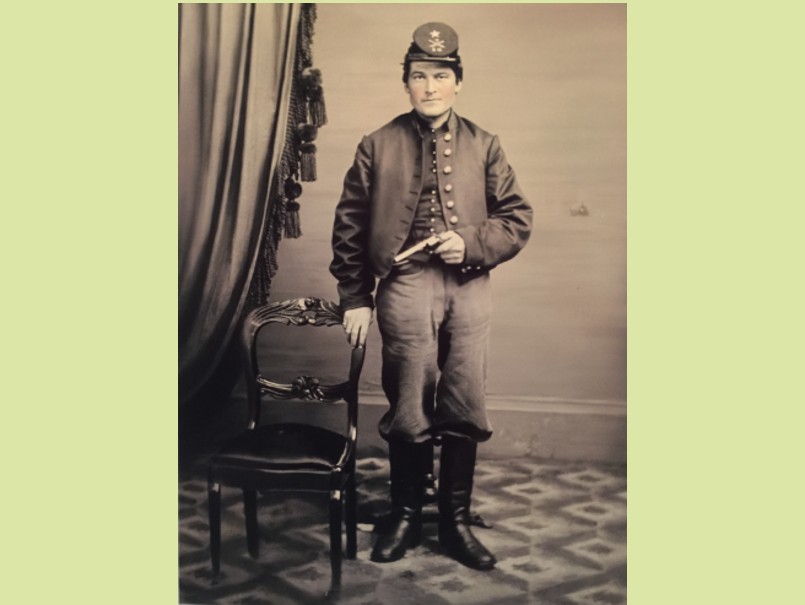
I do not know what my great-great-grandfather James Metcalf (above) saw at the Battle of Gettysburg. He and his father, Amos, my great-great-great-grandfather, were both there with the 6th Battery, 1st Battalion, Maine Light Artillery.
The list of locations (from the National Park Service) at which the 6th Battery saw action while my Metcalf ancestors served from November 15, 1861, till the war’s end includes the names of some of the bloodiest battles in Civil War history: Antietam, the Wilderness Campaign, the months-long Siege of Petersburg, and Gettysburg. James was a private and his father was a hospital cook, so perhaps their experiences were different ones. However, both died years after the war of diseases contracted in service: Amos was disabled with rheumatism and died in 1883, and James died of malaria in 1905. Amos was in his forties during the war, and James turned twenty in 1863.
Without a diary or letters, I do not know what either man saw or remembered from his experience or what drew them into service in the first place. Amos was from Nova Scotia, his wife Margaret Eagles was a First Nations Native Canadian, and the first three of their children (James included) were born in Nova Scotia, too. The rest were born in eastern Maine.
As a direct descendent, I am fascinated by a family that moved from Canada to Maine around 1850 (a son, Oliver, is counted in the 1870 U.S. Census as 19 years old and born in Maine and several other children were born, raised, and lived their lives in Maine) and then saw two members, father and eldest son, fight for the Union. Fascinated and proud, too.
(James and his French-Canadian wife, Annie Rioux, had a daughter, Effie, who married a rail engineer from Vermont named Charles Pearson. Charles and Effie were the parents of my father’s mother, Edith Pearson Aldrich.)
A century after Amos and James served, my late father served in Germany during the Cold War and his older brother served in Vietnam. An older brother of my grandfather’s (their father) served in World War I, and a younger brother of his is one of thousands of American World War II casualties buried in France: Walter Aldrich died during the Battle of the Bulge in November 1944, eighty years ago this month. On my mother’s side of the family, one of my great-uncles served in Europe also. He was a Jew who was present as the concentration camps were liberated.
The Aldrich family first came here in 1631, so I presume I am a direct descendent of at least one Revolutionary War veteran.
On this Veterans Day I think of all of the veterans among my family members, as well as the many veterans whom I have met and known. On this particular Veterans Day, in this particular time and place and moment, I think more of my Civil War ancestors, and what it meant to be a part of the Union. I do not know what it meant for them; I know what they mean to me.
President Lincoln’s First Inaugural Address gives us the phrase, “better angels of our nature.” When he delivered it at the unfinished Capitol Building—unfinished, it was dome-less, and its appearance was its own metaphor for the state of the nation—there was little he could have said or done that would have averted the Civil War. There was no guarantee that the war would happen, but enough people were looking for the fight rather than looking for areas of agreement so that the war was minutes instead of hours or months away. Once an anti-slavery-expansion, pro-Union Republican (a new political party) was elected president, secession began, and war loomed ever closer. (The southern states formed a new country, and the remaining states did not want them to leave but did not want them to stay in the Union with slavery as a part of their economy, so there were few available areas of agreement.)
Lincoln dedicated his speech to an explanation that secession is logically impossible, since a Union is a union (or a union is a Union), and to the promise that the federal government would not fire unless fired upon (which happened a couple weeks later, at Fort Sumter).
He concluded his address with an emotionally stirring paragraph, which began with this plaintive sentence: “I am loath to close.” He did not want to end the speech. He did not want to reach the conclusion.
It was almost as if he believed that the longer he talked, the longer the Union would remain. But he went ahead and finished with these famous words:
We are not enemies, but friends. We must not be enemies. Though passion may have strained it must not break our bonds of affection. The mystic chords of memory, stretching from every battlefield and patriot grave to every living heart and hearthstone all over this broad land, will yet swell the chorus of the Union, when again touched, as surely they will be, by the better angels of our nature.
His reference to “mystic chords of memory” has long been its own mystic chord of memory. We are so much further past Lincoln’s time than he was to the Spirit of 1776, yet my father saw Civil War veterans in his early childhood. They are still in living memory.
There was no response to Lincoln’s speech from the states that had seceded, no words offered, official or otherwise, until the attack on Fort Sumter. That attack was their reply, and then the war was on. Those southern newspapers that deigned to report on the new president’s very first speech focused on his “threats” (their word) to preserve the Union, and they ignored or insulted the concluding sentences that I quoted above. The “better angels” were seen with bitterness. There are no mystic chords for bitter angels. Most of the northern newspapers highlighted with optimism the “better angels” passage, on the other hand.
(I had an acquaintance, now deceased, who believed himself to be a Southerner more than an American, and he refused to allow pennies in his house, because “that man” is depicted on them. It would be comical, except it was not funny at all.)
In her book, Abraham Lincoln the Orator, a Binghamton University scholar named Lois Einhorn writes about the first inaugural address and the marked difference in reactions to it from North and South:
Selective listening, in effect, means that people hear what they expect and perhaps want to hear. All people listen selectively, hearing only part of any message. In the case of Lincoln’s Inaugural, one could expect a great deal of selective listening because the situation was marked by a high degree of prejudice and because Lincoln had said little to counter these prejudiced views. Many of the editorials evaluating the Inaugural Address support the view that selective listening and selective perception help account for the divergent reactions to the speech. Northern and Southern editorials tended to quote different portions of the speech: Northern editorials usually quoted the speech’s conciliatory peroration, while Southern editorials usually quoted Lincoln’s forceful statements about how he would treat the South.
“Selective listening” is an enormous phrase. Anything that I write about last week’s election will be merely some more words about last week’s election. I fear that the side that won chose to rework our nation’s self-definition in a way that is unique in our shared history. I hope it is my own “selective listening” that makes everything I read from the side that won sound like the opposite of an appeal to our better angels. Matters that I consider important and that friends of mine consider important are at best derided. At worst? People I care about, born and raised here, face the promise of deportation. There are others I worry about, too. I sit in worry about myself, my family, loved ones, but anything I write about the future will be merely some more words about the future.
I am loath to close for similar emotional reasons that Lincoln had. The future will be here, and it will be hard.
I do not know what Amos and his son James—and for that matter, Amos’ wife, Margaret, my First Nations great-great-great grandmother—saw as worthwhile in the United States of America. I do not know why they fought. I know what the emotion attached to the word “worthwhile” feels like, though; it must feel the same for me now as it did for them one hundred and sixty years ago.
Amos and James’ lives were forever altered and even shortened by the fight for something “worthwhile” in the Civil War. That is what that sort of fight will do. This Veterans Day, they are among my better angels of memory.
____________________________________________
Mark Aldrich is a journalist, award-winning humor columnist, and writer/performer with the Magnificent Glass Pelican radio comedy improv group, now in its thirty-fourth season:
Follow The Gad About Town on Facebook! Subscribe today for daily facts (well, trivia) about literature and history, plus links to other writers on Facebook.
Follow The Gad About Town on Instagram!


This work is licensed under a Creative Commons Attribution-NoDerivs 3.0 Unported License.

