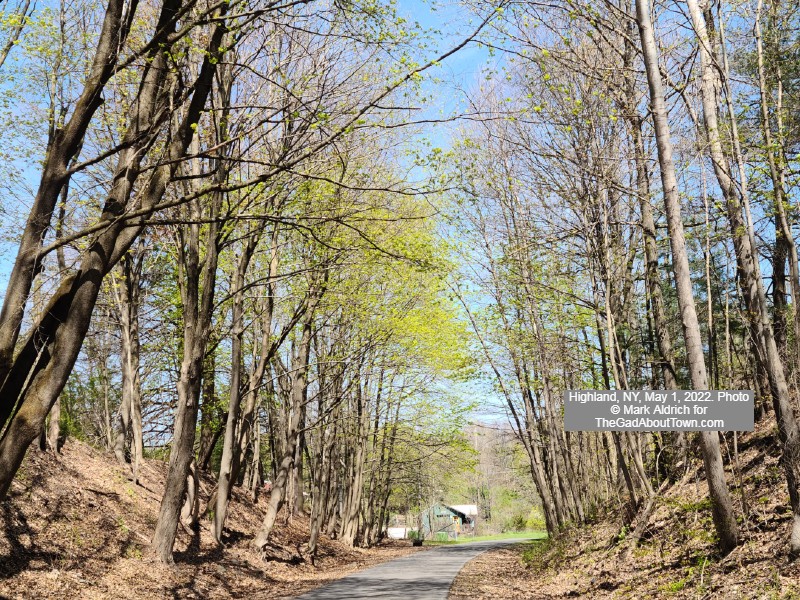
Begin afresh, afresh, afresh.
* * * *
When I entered her car last Wednesday morning, my friend’s greeting was, “What a beautiful day.” This is not always her greeting, not always the first thing I hear her say when I see her on Wednesdays, so from inside my current depression I stammered, “You … you mean the sunniness?”
We backed out into the road. It was indeed a sunny morning. “Yeah, I think we’re finally past the snow,” she added.
As you and your shovel may know, it was indeed a snowy winter this December and January and February and March in New Paltz, a prankster’s winter that gave us the biggest snowstorm in a couple years followed by a few unseasonably warm days followed by the biggest snowstorm in a decade and a week of below-zero nights. Small snowstorms then punctuated March. My friend’s tentative response (“I think we’re finally past the snow”) was the sensible one. More snow could yet arrive.
I needed that greeting, though. It was a sunny morning, and I had not yet noticed it.
One early spring day when I was a teen, I happened to look out the back window where we lived and noticed the trees were full of green buds. It was later in April than last Wednesday, so the trees were budding greener than they are right now. Decades later, I still remember that April morning with a vividness that makes me want to visit the home in which I grew up on some early spring morning, knock on the front door, and stare out the back window just to see if I can re-feel that feeling. The location isn’t important, so have no fear of my visit, dear residents of my childhood home on Sheraton Drive; the moment is what’s important.
I was so trapped in my teenage self that even though I spent a lot of time outside—I bicycled many places and I loved the woodland that abutted our backyard—I noticed nothing around me. I knew whatever I was supposed to know for school that week or month, I knew which bullies worried me at school, I knew my inner emotional weather, and I did not notice the weather outdoors. I couldn’t see beyond the inside of my eyeglasses. I had not noticed it was spring.
It was such an eye-opening moment that it moved me, was one of the first times I was moved by something outside myself and my own personal achievements or defeats, and each spring since I have looked for that same moment. I’ve so wanted that emotion again, to the degree that I’ve wanted to barge into my childhood home as if the emotion was especially located in our old dining room.
Of course, I have never had that moment or that emotion again for the very reason that I have in fact looked for it, tried to replicate it, tried to force my emotions to meet the world or the world to meet my emotions. Year after year, I would notice when the trees were a bit greener, acknowledge some happiness about it, and then move on to whatever I needed to know for work that week or month, whatever bullies or bosses worried me at work or in the neighborhood, whatever my inner emotional weather was. I often don’t see beyond the inside of my head, and that remains true even today.
The closest I’ve come that remembered moment was last Wednesday when I stammered, “You mean the sunniness?”
That stammer was where my 57-year-old self and my 17-year-old self re-met. It’s a moment captured in Philip Larkin’s beloved poem, “The Trees” but especially when read alongside his comments while he worked on it. In his mid-40s when he composed it, he privately called “The Trees” his “sixteen-year-old’s poem about spring, etc.” That “etc.” excoriates even more harshly than calling it a “sixteen-year-old’s poem.”
“The Trees” appears in High Windows, which contains many of Larkin’s most loved poems: “To the Sea,” “The Trees,” “Forget What Did,” “High Windows,” “This Be The Verse,” “Annus Mirabilis,” “Going, Going.” They are his most loved even though they are—or because they are—his bleakest. “This Be The Verse” opens with an attempt to shock: “They fuck you up, your mum and dad/They may not mean to, but they do … .”
To a friend, Larkin wrote about High Windows, “The new printing of HW came out, with 3 mistakes corrected but a new one introduced: there is talk of another—printing, not mistake.” (The Complete Poems of Philip Larkin, ed. by Archie Burnett, 2012)
That sarcastic tendency led him to reject and ridicule “The Trees” almost every chance he had. He called it “very modest.” He referred to it as his “sixteen-year-old’s poem.” The sentiments expressed were those of a teenager and not a mature man from his perspective.
“First verse all right, the rest crap, especially the last line.” Oh, that last line. That last line is almost optimistic, at least in its acknowledgement that there is something we refer to as “the future,” that there is a beginning that we are in each spring. Hence Larkin’s out-of-hand rejection of it.
But he wanted it to reflect the reality of optimism. He saw it as something out of Wordsworth, and he wrote to Monica Jones (his companion) that his ambition was for the concluding stanza to “lift the thing up to a finish.”
That is the war inside Larkin: a reflexive rejection of all things humane inside us ugly humans as sentimental concerns over things that are cloying or “crap,” yet a respect as a writer for the simple existence of those sentimental things; our acknowledgement of something we call the future—and our notion that one’s hopes about the future, while often dashed, are not dashed when we have them at first—is something he catches a hold of in “The Trees,” even while he hates it. He could not reject it quickly enough, which is why he ridiculed the poem while he composed it. At the end, the poem won out over his private rejection of it.
That last line he hated? “Begin afresh, afresh, afresh.”
The trees are coming into leaf
Like something almost being said;
The recent buds relax and spread,
Their greenness is a kind of grief.
Is it that they are born again
And we grow old? No, they die too,
Their yearly trick of looking new
Is written down in rings of grain.
Yet still the unresting castles thresh
In fullgrown thickness every May.
Last year is dead, they seem to say,
Begin afresh, afresh, afresh.—Philip Larkin, “The Trees”
____________________________________________
Mark Aldrich is a blogger for Yokel Enterprises, an award-winning humor columnist, and a writer/performer with the Magnificent Glass Pelican radio comedy improv group, which just completed its thirty-fifth season:
Follow The Gad About Town on Facebook! Subscribe today for daily facts (well, trivia) about literature and history, plus links to other writers on Facebook.

This work is licensed under a Creative Commons Attribution-NoDerivs 3.0 Unported License.
 The Gad About Town